
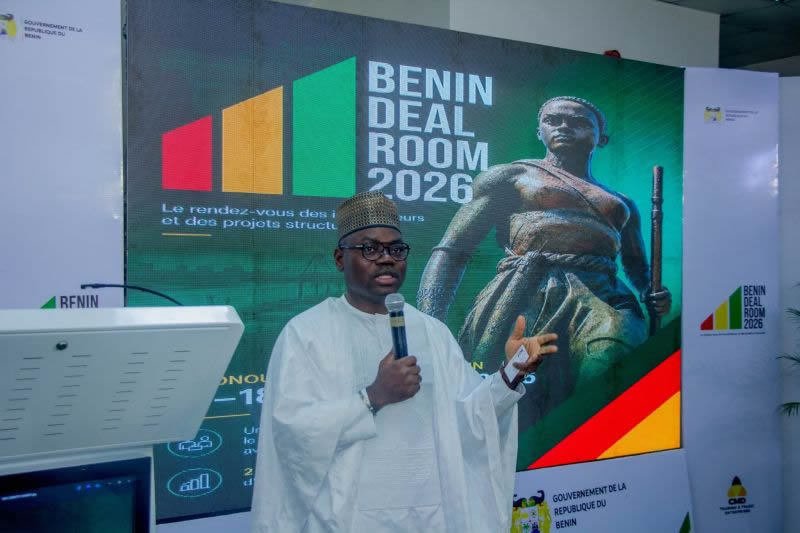
The Republic of Benin has unveiled a new investment platform aimed at connecting global capital with more than 20 government-backed projects valued between US$2 billion and US$3 billion, as the West African country steps up efforts to attract long-term financing into strategic sectors of its economy.
Known as the Benin Deal Room 2026 (BDR 2026), the initiative will bring together sovereign investors, development finance institutions, private equity firms, commercial banks and strategic corporations for a three-day investment forum scheduled for 16–18 September 2026 in Cotonou.
Unlike a traditional investment conference, the platform is designed around a prepared pipeline of projects that have undergone technical and commercial assessment before being presented to investors. Organisers say the objective is to move beyond investment discussions and create a structured pathway towards financing and implementation.
The initiative was formally introduced during a diplomatic and investor briefing held at the Embassy of the Republic of Benin in Abuja on 1 July 2026, with ambassadors, senior diplomats accredited to Benin, business leaders, development partners and prospective investors from across the region in attendance.
The Benin Deal Room is being coordinated by the Directorate General for Economic Attractiveness and Diplomacy (DGADE) under the Ministry of Foreign Affairs, in partnership with the Ministry of Tourism and Foreign Trade in charge of African Integration, Industry and the Promotion of Private Investment (MTCE), the Investment and Export Promotion Agency (APIEx), and the Embassy of Benin in Nigeria.
Several national institutions are supporting the initiative, including the Ministry of Economy and Finance, the Real Estate and Urban Development Company (SIMAU), the Glo-Djigbé Industrial Zone (GDIZ), the Investment and Industry Promotion Company (SIPI), and the Chamber of Commerce and Industry of Benin (CCI-Benin). CMD Tourism and Trade Enterprises Ltd is serving as the implementing partner.
At the centre of the platform is a curated deal book containing infrastructure, industrial and investment opportunities supported by detailed commercial and technical information. The portfolio will provide investors with project details including capital requirements, sponsor profiles, regulatory approvals, implementation progress, expected revenue models, and environmental and social risk assessments.
Admission into the portfolio will be based on a formal investment-readiness review, ensuring that only projects with sufficient technical preparation, commercial viability and implementation structures are presented to potential financiers.
The investment process has also been designed to shorten the journey between investor engagement and financial closure and is tructured by PAC Capital, the Lead Transaction Advisory Partner for BDR 2026, with a target of securing at least five signed Memoranda of Understanding by March 2027. Projects that progress to the term-sheet stage are expected to benefit from secure data rooms, dedicated transaction teams and post-forum support through a 60-day Transaction Desk established to assist with due diligence, negotiations and deal execution.
Speaking at the Abuja briefing, Director General of APIEx, Eric Akouté described Nigeria as one of Benin’s most important commercial partners and noted that the platform was designed to deepen business connections between the two neighbouring economies.
“We want to create business relationships and business partnerships with Nigerian businesses. What we can do for each other is to connect. We have come to promote our country and see how we can do business with them,” he stated.
The investment drive builds on Benin’s wider industrialisation strategy, which has identified special economic zones as a key vehicle for expanding manufacturing and increasing value addition.
A major component of this strategy is the Glo-Djigbé Industrial Zone (GDIZ), located near Cotonou, which focuses on processing locally produced commodities such as cotton, cashew, pineapple, shea and soybeans into finished products for domestic and international markets. The zone is intended to strengthen industrial capacity, boost exports and create new opportunities for private-sector investment.
CMD Tourism and Trade Enterprises Chief Executive Officer, Cecile Mambo highlighted that the Benin Deal Room would help redirect investment into structured commercial channels, particularly in manufacturing, agro-processing and export-focused industries where developments such as GDIZ are creating new opportunities.
Also addressing participants, Dr. Aliyu Idi Hong, Second Deputy President of the Abuja Chamber of Commerce and Industry, highlighted the longstanding economic and historical links between Nigeria and Benin, describing them as a foundation for stronger private-sector collaboration.
Tunisia’s Ambassador to Benin, resident in Abuja, Mohsen Anitit, noted that the initiative reflected Benin’s growing confidence in presenting bankable opportunities to international investors.
“Benin is not waiting for investment. Benin is organising it, structuring it, and presenting it to the world with clarity and confidence,” he said.
The September forum in Cotonou will bring together three main groups — investors, project sponsors and strategic partners — through investment presentations, private business meetings and technical discussions aimed at accelerating financing decisions.
Ahead of the meeting, institutional investors, development finance institutions and strategic corporations have been invited to request investor briefs, indicate sector interests and identify suitable project opportunities as Benin seeks to convert its investment pipeline into concrete partnerships and transactions.
Related Posts