
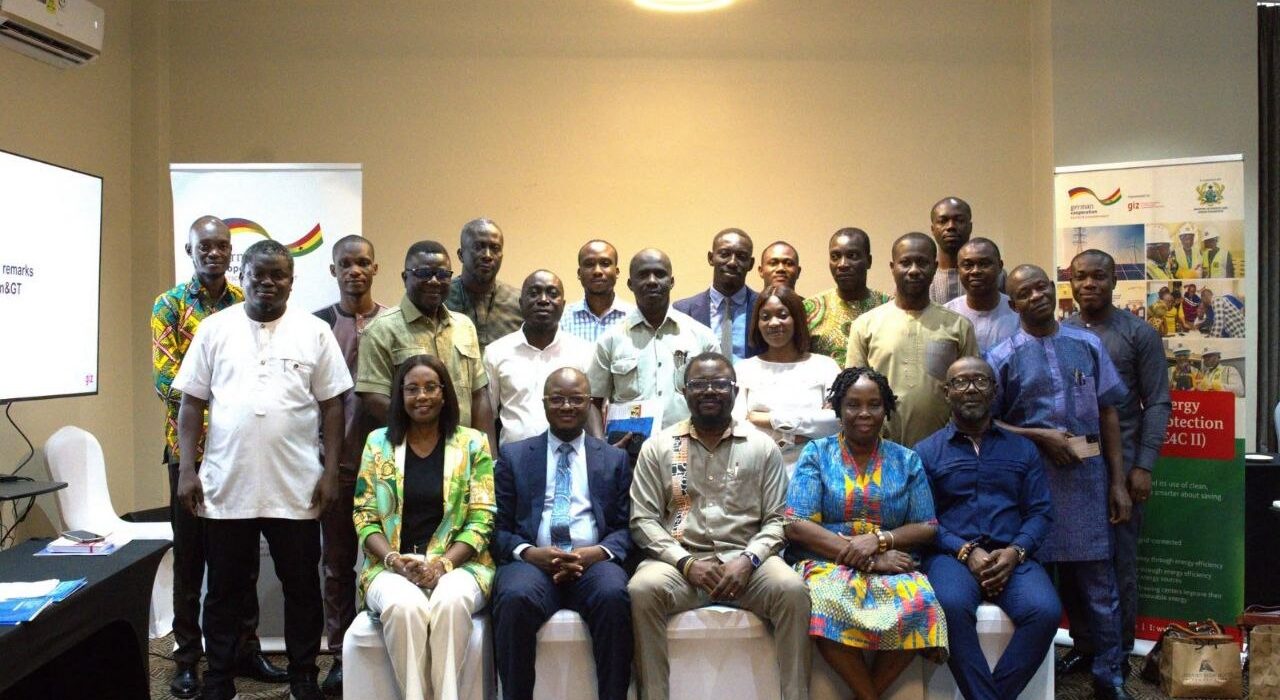
Germany’s development cooperation agency, GIZ, has brought together key stakeholders in Ghana’s energy and technical and vocational education and training (TVET) sectors to review progress in solar technician training and strengthen institutional capacity to support the country’s renewable energy transition.
The engagement was held under the Sustainable Energy for Climate Protection II (SE4C II) project, a German-funded programme implemented by GIZ in partnership with Ghana’s Ministry of Energy and Green Transition. The project, which runs from March 2025 to February 2028, has a €7 million implementation commitment and seeks to increase the share of renewable energy, improve energy efficiency and strengthen Ghana’s energy system.
The workshop brought together representatives of the Ministry of Energy and Green Transition, the Energy Commission, the Commission for Technical and Vocational Education and Training (CTVET), the Ghana TVET Service and 12 TVET institutions implementing the Solar Technology Competency-Based Training Programme. Principals and course coordinators from the participating institutions reviewed implementation progress and developed institutional roadmaps to strengthen the delivery of solar technology training.
The discussions placed particular emphasis on the role of TVET in producing the skilled workforce required to support Ghana’s growing renewable energy sector. Speaking on behalf of the Minister of Energy and Green Transition, the Director for Renewables and Green Transition, Seth Mahu, underscored the need to develop a critical mass of skilled personnel capable of supporting the country’s renewable energy ambitions.
He called on TVET institutions and other stakeholders to strengthen their contribution to skills development, noting that the expansion of renewable energy would require technicians and other professionals equipped with practical, industry-relevant competencies. The focus on solar technology is consistent with GIZ’s broader support for Ghana’s TVET system, including efforts to align vocational training with labour-market requirements and strengthen green and digital skills.
The workshop also advanced discussions on developing a dedicated net-metering training unit for TVET institutions. The proposed training is expected to give students practical knowledge of the systems through which electricity generated from renewable sources can be supplied to the grid, extending their skills beyond the physical installation of meters to include the wider technical requirements of integrating distributed solar generation into Ghana’s electricity network.
Net metering is also a specific component of SE4C II, which supports measures to compensate households for solar electricity fed into the grid. The project forms part of Germany’s wider cooperation with Ghana to strengthen grid stability, reduce electricity consumption and expand the use of renewable energy, particularly solar power.
The latest intervention builds on results achieved under the first Sustainable Energy for Climate Protection programme, which had already established a foundation for renewable energy training in Ghana’s TVET system. According to GIZ, several hundred students enrolled in solar photovoltaic technology courses at 10 public TVET institutes under the earlier programme, with more than 100 students having successfully completed the course. The programme also supported the training of teachers, development of curricula and teaching materials, and technical equipment for selected vocational institutions.
The earlier programme also contributed to Ghana’s broader renewable energy and energy-efficiency agenda through the development and adoption of a Sustainable Energy Action Plan for Public Institutions. GIZ reported that the plan was designed to facilitate the installation of solar energy systems at 1,170 public facilities, including schools, hospitals and water supply systems, while supporting energy-efficiency measures across another 2,500 public facilities.
SE4C II is now expanding that foundation by working with the state, energy suppliers and business associations on measures intended to improve the conditions for renewable energy investment and deployment. GIZ identifies grid stability, energy efficiency and net metering as key areas of intervention, with the expected benefits including fewer electricity outages, lower energy costs and reduced greenhouse-gas emissions.
The project also forms part of Germany’s broader support for Ghana’s TVET transformation, which includes strengthening the capacity of TVET institutions, improving the practical and teaching skills of instructors, increasing private-sector participation and expanding green and digital education. Through the solar technician training component, the partnership is seeking to ensure that Ghana’s renewable energy expansion is matched by a workforce capable of installing, operating and maintaining the technologies needed to support the country’s energy transition.
Related Posts