
Ghana and the Republic of Korea have deepened cooperation on cultural heritage conservation with a US$4.5 million commitment to support the restoration and climate resilience of six historic forts and castles forming part of Ghana’s UNESCO World Heritage property.
The initiative, known as the Korea-Ghana Heritage Project on Climate Change Impact on Forts and Castles of Ghana World Heritage Property, is aimed at strengthening Ghana’s capacity to assess, monitor and respond to the growing environmental threats facing its coastal heritage sites. The project follows Ghana’s recent engagements with the Korean National Commission for UNESCO on improving the conservation and management of the country’s World Heritage properties.
The intervention comes at a time when Ghana’s historic forts and castles face increasing exposure to coastal erosion, wave action, flooding and other environmental pressures associated with a changing climate. UNESCO has specifically identified the vulnerability of the property to environmental pressures, noting that some of the ruins are susceptible to wave action and that the sea has already damaged a substantial part of Fort Prinzenstein at Keta.
Fort Prinzenstein provides one of the clearest examples of the scale of the threat. UNESCO reports that the sea has attacked a major portion of the fort, although its protection has been enhanced through the construction of a sea defence wall and efforts to stabilise the remaining structure. The UNESCO Courier has also reported that parts of Fort Prinzenstein have been destroyed by coastal erosion, while Fort Kongenstein at Ada has been completely washed away.
The wider coastline presents a significant conservation challenge for Ghana’s coastal heritage. UNESCO estimates that Ghana’s coastline is retreating at an average rate of about two metres annually, with some locations experiencing considerably higher rates of erosion. A UNESCO assessment further found that climate-related threats, including coastal erosion and unpredictable torrential rainfall, could exacerbate existing weaknesses in the structural integrity of the Forts and Castles World Heritage property.
The first phase of the Korean-supported intervention will focus on six selected sites in the Greater Accra area and its adjoining coastal zone: Ussher Fort, James Fort, Christiansborg Castle, Fort Augustaborg, Fort Vernon and Fort Fredensborg. The Ghana Museums and Monuments Board lists the sites among the country’s protected forts and castles, with Fort Vernon located at Prampram and Fort Fredensborg at Old Ningo.
The project is expected to establish a more systematic approach to climate-risk assessment and monitoring of the selected heritage sites. It will bring together government institutions, technical agencies, local communities, academic institutions and international partners to strengthen the scientific basis for conservation decisions and develop responses suited to the specific climate risks confronting the sites.
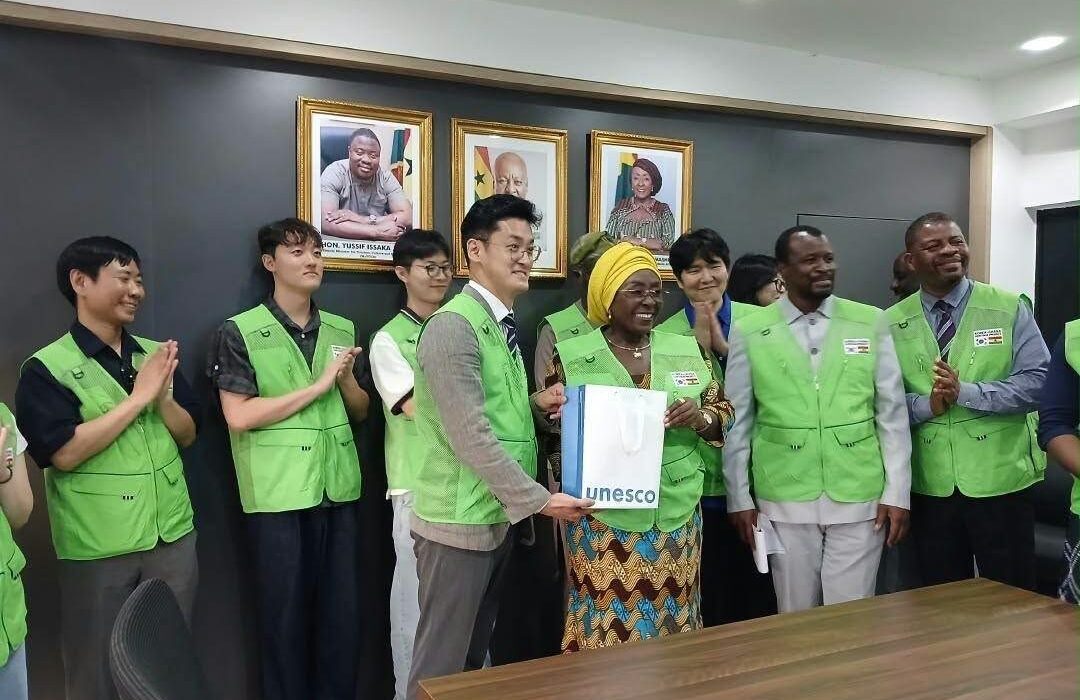
Capacity development is also a major component of the partnership. Six Ghanaian officials from institutions including the Ministry of Tourism, Culture and Creative Arts, the Ghana National Commission for UNESCO, the Ghana Museums and Monuments Board and the Environmental Protection Agency recently completed specialised training in South Korea on managing the impacts of climate change on cultural heritage. The training formed part of the broader cooperation between Ghana and the Korean National Commission for UNESCO.
The cooperation is also expected to strengthen Ghana’s heritage management systems beyond physical restoration. Earlier in July 2026, a policy-makers’ programme in South Korea under the Korea-Ghana Heritage Project brought Ghanaian officials together for lectures, policy discussions and visits to heritage conservation sites, with the programme contributing to the development of a proposed Heritage and Climate Change Policy for Ghana’s Forts and Castles World Heritage property.
The Korean intervention builds on Ghana’s wider efforts to address longstanding conservation challenges affecting the World Heritage property. UNESCO’s monitoring missions have identified weaknesses including inadequate maintenance and conservation resources, insufficient documentation and research, poor regulation of development around some sites and the absence of adequate buffer zones. Ghana has subsequently adopted an Integrated Management Plan for the Forts and Castles covering 2024–2029.
The Korean delegation involved in the cooperation has included officials from the Korean National Commission for UNESCO, with Jinsung Jeon, Director of its Culture Division, among the commission’s representatives working on international heritage cooperation. The partnership is expected to strengthen technical exchanges between Ghanaian and Korean heritage institutions while supporting the long-term protection of sites that form an important record of Ghana’s history and the wider history of European-African encounters and the African diaspora.
Related Posts