
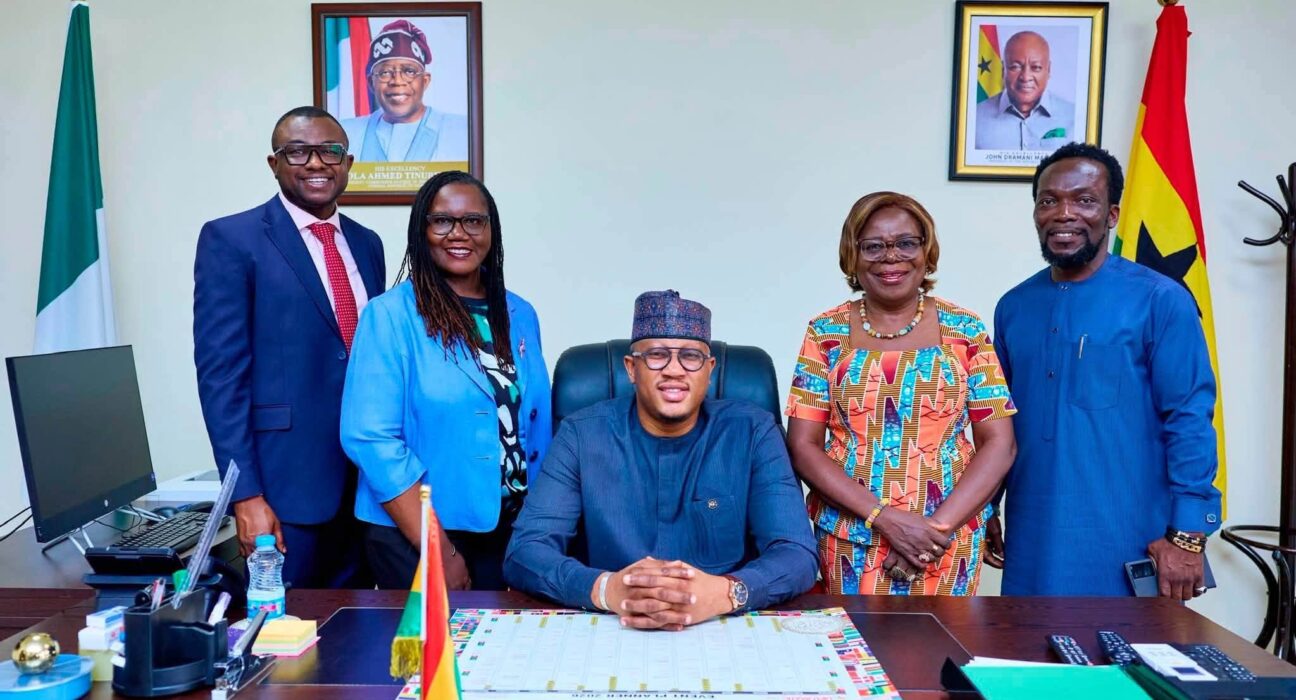
Ghana’s High Commissioner-designate to Nigeria, Baba Sadiq Abdulai Abu, has begun his assignment in Abuja, formally assuming leadership of the Ghana High Commission at a critical moment for relations between two of West Africa’s most influential countries.
He over the leadership of the Mission from the Deputy Head of Mission, Dr Mrs Gladys Mansa Yawa Akyea, who had been serving as Acting Head of Mission following the recall of former High Commissioner, Baba Jamal.
His assumption of duty marks the beginning of a new diplomatic tenure in Abuja, where Ghana’s engagement with Nigeria remains central to its broader foreign policy, regional integration and economic diplomacy agenda.
As part of his initial engagements, the High Commissioner-designate met with staff of the Mission across all levels, including management, senior and junior officers, to gain firsthand insight into the work of the High Commission and the issues that have shaped Ghana’s diplomatic engagement in Nigeria.
He said the engagement provided an important opportunity to establish a shared understanding of the Mission’s priorities and set the tone for his tenure, with a focus on advancing Ghana’s national interests and further strengthening the longstanding relationship between Ghana and Nigeria.
“The meeting provided an important first opportunity to engage the Mission and set the tone for my tenure, with a shared commitment to advancing Ghana’s interests and further strengthening the longstanding relations between Ghana and Nigeria,” he stated.
Ghana and Nigeria share one of the most important bilateral relationships in West Africa, anchored in deep historical, political, economic and people-to-people ties.
As two of the region’s leading economies and influential members of the Economic Community of West African States, cooperation between Accra and Abuja has often carried implications beyond their borders, particularly on regional peace, security, trade and the future of West African integration.
The relationship has also recorded significant successes. Ghana and Nigeria have remained key partners in promoting peace and stability within the ECOWAS sub-region, while their shared influence has been critical to regional diplomatic engagement and collective responses to political and security challenges.
Both countries have also recently reaffirmed their commitment to strengthening cooperation across trade, investment and regional affairs. In July, Ghana’s Foreign Minister, Samuel Okudzeto Ablakwa, and Nigeria’s Minister of State for Foreign Affairs, Ambassador Sola Enikanolaiye, held bilateral discussions on the margins of the ECOWAS Mid-Year Summit in Freetown, where they agreed on the need for stronger strategic consultation and preventive diplomacy to address irritants before they escalate into major bilateral concerns.
The two governments have also identified economic cooperation as an area requiring renewed attention. During the presentation of the Nigerian High Commissioner-designate’s Open Letters in Accra in July, Mr Ablakwa called for the removal of trade barriers and closer collaboration to increase bilateral trade, while urging both countries to take fuller advantage of opportunities under the African Continental Free Trade Area
Trade-related tensions have also remained a recurring source of friction. Most recently, Ghana and Nigeria had to intervene diplomatically to address a dispute involving onion traders, which disrupted supplies and raised concerns about the vulnerability of commercial relations between traders in the two countries.
Both countries have also periodically faced tensions over the operation of Nigerian-owned businesses in Ghana’s retail sector. The dispute centres largely on the apparent tension between ECOWAS provisions on the free movement and establishment of citizens within the region and Ghana’s domestic investment laws, which reserve petty trading and certain retail activities for Ghanaians.
The issue has, over the years, resulted in the closure of Nigerian-owned shops and recurring confrontations between Ghanaian and Nigerian traders, making retail trade one of the most persistent sources of friction in an otherwise strong bilateral relationship.
These developments underscore one of the central challenges for Ghana’s diplomatic engagement in Nigeria: translating the strong political and historical relationship between Accra and Abuja into deeper and more resilient economic cooperation, while ensuring that commercial disputes and other irritants are managed before they strain broader bilateral ties.
The relationship is also taking on greater strategic importance as ECOWAS confronts significant political and security challenges, including the withdrawal of Burkina Faso, Mali and Niger from the bloc. The changing regional environment has increased the importance of cooperation among member states such as Ghana and Nigeria in sustaining regional stability and advancing the integration agenda.
Against this backdrop, Mr Abdulai Abu’s tenure in Abuja is expected to place renewed emphasis on economic diplomacy, trade promotion, the protection of Ghanaian interests and the strengthening of political and institutional engagement between the two countries.
As part of his early engagements, the High Commissioner-designate also met with the Deputy Chief Executive Officer of the Ghana Export Promotion Authority, Abdul Rashid Kramer, ahead of Ghana’s participation in GITEX Nigeria.
The engagement points to an early focus on commercial and digital diplomacy, particularly as Ghana seeks to position its businesses and technology sector within one of Africa’s largest and most dynamic markets.
GITEX Nigeria offers Ghana an opportunity to showcase its growing digital and technology ecosystem, promote Ghanaian enterprises and explore new partnerships in innovation, digital trade and technology-driven business.
For the Ghana High Commission in Abuja, such engagements could become increasingly important in converting diplomatic goodwill into concrete commercial opportunities, particularly at a time when both governments are seeking to deepen trade and investment ties and unlock opportunities under AfCFTA.
Related Posts