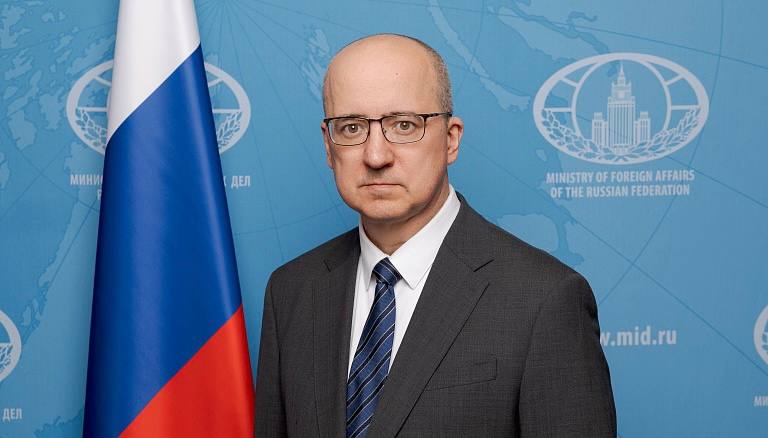
In a written response, Russian Ambassador to Ghana Andrei Ordash outlined Moscow’s position, welcoming the decision while stressing the need for it to be guided by practical economic considerations.
Question 1. What is Russia’s position on Ghana’s quest to join BRICS, and what concrete steps would Ghana need to take to advance its ambition?
Russia respects Ghana’s sovereign choice and its desire to broaden its circle of international partners, diversify its foreign economic ties and play a more active role in shaping a fairer system of international relations.
We welcome Ghana’s growing interest in BRICS and regard it as evidence of Ghana’s readiness to deepen cooperation with states that are playing an increasingly prominent role in the global economy and international politics.
BRICS is an association of states that interact on the basis of sovereign equality, mutual respect, consideration of national interests and consensus. It is not directed against any countries and does not require its members to cease cooperation with other international partners.
On the contrary, one of the group’s most important objectives is to expand opportunities for states to independently determine their own paths of development.
Note that decisions on expansion are taken by all BRICS members by consensus and in accordance with established procedures.
For its part, Russia is ready to engage in constructive dialogue with its Ghanaian partners on matters relating to cooperation with BRICS, to share its experience and to facilitate the development of ties with this organisation.
Ghana’s interest in BRICS deserves serious and substantive consideration. It is important that such work is underpinned by concrete measures – the development of trade, investment, industrial cooperation, scientific and technical ties, and other areas that serve the long-term interests of the Ghanaian people.
Question 2. What economic benefits could BRICS membership realistically offer Ghana in areas such as trade, investment, energy and access to finance, beyond the diplomatic significance of joining the bloc?
Today, BRICS member states account for 47 per cent of the world’s population, over 30 per cent of the world’s agricultural land, as well as 40 per cent of global GDP at purchasing power parity and 23 per cent of total global trade. The volume of trade between the member countries of the group stands at around 1.2 billion USD.
Membership of BRICS broadens opportunities for access to the large and rapidly developing markets of the member countries. This is facilitated, among other things, by an extensive architecture of mechanisms and platforms that enable partnerships to be forged in virtually all sectors of the economy, both at the level of government bodies and through business communities.
It is also important to understand that BRICS is not a single trade market with a common customs territory, nor does it have a universal financial fund that automatically provides funds to all participants.
Therefore, tangible economic results will depend on the substance of the agreements concluded, the competitiveness of enterprises, the quality of investment projects and the willingness of the partners themselves to participate in their implementation.
Russia is keen to develop trade and economic cooperation with Ghana and sees opportunities to expand collaboration in the energy sector, industry, agriculture, education, science and technology. Russian and Ghanaian enterprises can explore promising joint projects, including those involving partners from other BRICS countries.
Question 3. Some observers question whether closer alignment with BRICS could complicate Ghana’s relations with Western partners. How would Russia address those concerns, and what assurances can you give Ghana about the practical value of the membership?
We understand that, when making foreign policy and economic decisions, the Ghanaian leadership takes into account a wide range of factors, including relations with Accra’s traditional partners.
At the same time, we believe that a potential partnership with BRICS should not be viewed as a choice between one set of partners and another. The group itself does not imply a severing of existing international ties or compulsory membership of any blocs. Its main value lies in creating additional opportunities for dialogue, coordination of positions and practical cooperation between states with different economic models and national priorities.
Ghana is entitled to determine for itself how to balance its cooperation with BRICS states, Western countries, African partners and international financial institutions.
Russia takes the view that such a decision falls within the exclusive competence of the Ghanaian state. We do not view the development of Ghana’s ties with BRICS as grounds for it to abandon its relations with other countries, nor do we make cooperation with Russia contingent upon such decisions.
As for concerns regarding possible negative consequences, we believe these should be assessed on the basis of specific circumstances, rather than on the mere fact of participation in the group. Expanding partnerships can contribute to the diversification of trade flows, an increase in the number of potential investors and the emergence of additional financing options. Of course, this does not rule out commercial and financial risks.
Russia advocates international cooperation based on mutual respect, equality and due regard for the legitimate interests of all parties.
We are convinced that African states must be able to choose their own partners for economic development without external pressure. This approach is particularly important for countries seeking to accelerate industrialisation, develop national infrastructure and raise the standard of living of their populations.
Related Posts