

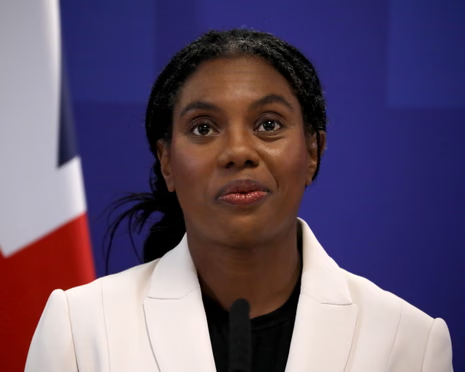
The Leader of the UK Conservative Party, Kemi Badenoch, has criticised the Labour government’s decision to impose new trade restrictions and sanctions targeting Israeli settlements in the occupied West Bank, describing the measures as counterproductive to British national interests and politically motivated.
Foreign Secretary Ed Miliband announced the measures on September 8, including a ban on imports of goods produced in Israeli settlements and sanctions targeting individuals and companies that support, facilitate or profit from settlement activity. The government said the measures were intended to protect the prospects of a two-state solution and respond to what it described as the unlawful expansion of Israeli settlements and violence against Palestinians.
Badenoch argued that while the actions of Israel, a democratic state, could be criticised, the government’s decision risked undermining British security and diplomatic interests at a time when the United Kingdom faces threats from Iran and its proxies.
She maintained that Britain and Israel share common security threats and warned that weakening relations with Israel could affect intelligence cooperation that has contributed to protecting lives in the United Kingdom.
“We face common enemies. Iran and its proxies do not only threaten Israel. MI5 has warned that the Iranian regime has plotted violence on British soil and targeted people living in this country. At a time when we face a serious terrorist threat, deliberately damaging relations with a country whose intelligence helps save lives here is madness,” she stated.
Badenoch further accused the Labour government of putting party-political considerations ahead of Britain’s national interest, arguing that the sanctions were designed to appeal to Labour MPs and activists rather than address the country’s immediate domestic priorities.
She pointed to border security, law and order, economic growth and the cost of living as issues she believes should receive greater attention from the government, while alleging that Labour was seeking to regain support from Islamist and far-left voters.
“The Labour Party is putting Britain’s national interests second in an attempt to win back support from Islamist and far-Left activists,” she stated, while also linking the government’s position to the political contest over the constituency previously held by former Prime Minister Keir Starmer.
Her concerns were echoed by Conservative Shadow Foreign Secretary Tom Tugendhat, who warned before the sanctions were announced that damaging relations with Israel could affect Britain’s intelligence-sharing arrangements and make it harder to prevent terrorist attacks.
Mr Tugendhat, a former security minister, described Israel as one of Britain’s most important intelligence partners and argued that cooperation between the two countries had helped prevent attacks on British soil. He also warned that turning Israel into a “pariah” could risk greater sectarian division in Britain and a rise in antisemitic violence.
Jonathan Hall KC, the UK’s independent reviewer of terrorism legislation, also highlighted the importance of international cooperation, particularly intelligence-sharing with countries such as Israel in dealing with threats linked to Iran. He nevertheless acknowledged concerns surrounding settler violence, noting that some settler violence could itself amount to terrorism.
Beyond the security concerns, the measures have triggered immediate diplomatic consequences. Israel announced that it would close Britain’s consulate in East Jerusalem and bar several British officials and politicians from entering the country in response to the sanctions. Foreign Secretary Miliband described the Israeli retaliation as “regrettable and damaging” but maintained that Britain could not allow the prospect of reprisals to prevent it from acting over settlement expansion.
The measures have also raised concerns over Britain’s relationship with the United States, with US officials expressing opposition to the British approach. Critics have warned that a widening diplomatic rift with Israel could complicate Britain’s broader strategic relationships in the Middle East and with Washington.
However, the British government’s position has received support from several European countries. France and Canada joined the United Kingdom in announcing restrictions on trade linked to Israeli settlements, while Denmark, Finland, Iceland, Norway, Poland, Portugal, Spain and Sweden have also expressed support for further action. Ireland’s Foreign Minister Helen McEntee welcomed the coordinated measures and called for the European Union to go further by prohibiting trade with Israeli settlements in accordance with international law.
The European Union itself has already imposed targeted sanctions on individuals and entities linked to extremist settler activity. In May 2026, the EU adopted additional restrictive measures under its Global Human Rights Sanctions Regime, citing serious and systematic human rights abuses against Palestinians and warning that settlement expansion and violence were undermining the viability of a two-state solution.
The debate therefore reflects a growing divide over how Western governments should balance relations with Israel, counterterrorism and intelligence cooperation against concerns over settlement expansion, Palestinian rights and the prospects for a two-state solution.
While Badenoch and other Conservative figures argue that the sanctions risk weakening Britain’s security partnerships and exposing the country to wider diplomatic and economic consequences, the Labour government maintains that continued settlement expansion requires Britain to move beyond condemnation and take concrete action to preserve the possibility of a Palestinian state.
Related Posts