
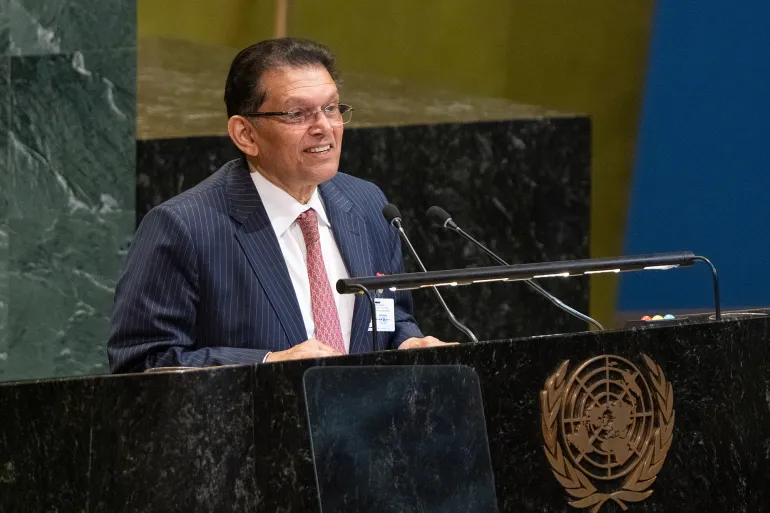
Mr. Secretary General, Excellencies, ladies and gentlemen, it’s a profound honour to stand before you as President of the General Assembly for its 81st session. Let me begin by expressing my deep gratitude to Prime Minister Tariq Rahman and the Government of Bangladesh for nominating me to this esteemed office, and to all of you for your trust and support. I will discharge my responsibilities to the best of my ability with fairness, independence, and integrity.
Allow me also to recognise my predecessor, Miss Annalena Baerbock, who shepherded this assembly through a challenging year. I thank her for the support afforded to me and my team throughout the transition. I assume this responsibility at a consequential moment for the organisation.
As the United Nations enter its ninth decade, we should acknowledge the many achievements that deserve recognition. There is one, above all, that stands apart. For more than eight decades, our organisation has helped the world avoid plunging into a third world war, arguably the very reason for its existence.
The United Nations has also helped articulate the development vision of dozens of countries, the vast majority of which were not present at the creation of the organisation in 1945. And it has helped bring emerging and contemporary challenges faced by the world community, from climate change to the governance of artificial intelligence, to the forefront of our deliberations.
Every day, often far from the spotlight, the United Nations and its dedicated core of professions work to feed millions of people, including refugees and other displaced populations around the world, support peace and security, combat chronic diseases, and help countries address complex transboundary challenges.
These are the United Nations’ unsung heroes, the people whose indispensable contributions rarely make the evening news, yet whose impact is felt every day in communities around the world. It is in their tireless efforts that we see the best of the United Nations and the enduring value of multilateral cooperation. They deserve our full recognition.
At the same time, we must speak candidly about the grave challenges before us. The United Nations has often fallen short of the expectations placed upon us. Conflicts continue to inflict immense human suffering.
Development gains remain feeble and fragile. Climate impacts are intensifying. Together, these challenges have brought trust in multilateralism under tremendous strain.
A widening trust deficit is testing confidence in international institutions and collective action. A deficit that we must close by working together through dialogue, renewed cooperation, and delivery. Indeed, trust is the quiet force behind every understanding we reach, every agreement we sign, and every resolution we adopt.
The understanding that each of us will shoulder our respective share of the burden, honouring commitments we make. Today, our responsibility is not merely to defend this institution, there are good reasons to do that, but to strengthen it, not simply to invoke trust on which multilateralism rests, but to earn it every day.
My pledge for the 81st session, dear colleagues and friends, is to work tirelessly to revive trust in this institution upon which success of our collective action ultimately depends.
This conviction is the spirit behind the theme of this 81st session, “Restoring trust, managing transformation: a United Nations that delivers for all. Excellencies, friends, and dear colleagues, restoring trust requires both delivery and reform. We must prove through concrete results that this institution effectively serves the 8 billion people in whose name we act.
With that in mind, I’ll focus the work of this assembly around six priorities in the year ahead. First, and perhaps more fundamentally, we must strengthen peace and security in keeping with the Charter’s promise to save succeeding generations from the scourge of war.
With full respect to the mandates of the relevant organs of the organisation, I’ll collaborate closely with the member states and with the President of the Security Council and Secretary General to support the UN’s work on conflict resolution, peacekeeping, and peacebuilding, drawing inspiration from the more than 200,000 Bangladeshis who have served in the United Nations peacekeeping.
I will champion a people-centred approach to peace that puts prevention and political solution first. Second, we must accelerate sustainable development and ensure that no country is left behind. With only four years left to achieve the 2030 agenda and just 36 percent of SDG targets on track or making moderate progress, the gap between ambition and delivery is far too wide.
Ahead of the 2027 SDG Summit and building on the compromises of this area, I will work with you to close the SDG financing gaps, advance debt sustainability, and pursue reform of the international financial architecture with particular attention to the least developed countries, landlocked developing countries, and small island developing states.
I will work to strengthen cooperation with the African Union in support of Agenda 2063 and convene the mandated General Assembly meeting to address the particular challenges facing middle-income countries.
Third, and inseparable from our development ambitions, we must accelerate climate action, particularly in the areas of adaptation and resilience.
I will work with Member States ahead of COP 31 to advance the operationalisation of the Loss and Damage Fund and champion greater climate finance for those most vulnerable and on the front lines of climate impacts. Later this month, the Assembly will convene its high-level meeting on sea level rise, an existential matter for small island developing states and low-lying coastal nations everywhere.
And recognising that the climate crisis cannot be separated from the health of our ocean and biodiversity, I will use key processes, including the Ocean Decade and the first Conference of the Parties to the Agreement on Marine Biological Diversity of Areas Beyond National Jurisdiction, or BBNJ Agreement, to advance science-based ocean action and stronger partnerships.
Fourth, I will work to advance human rights and uphold the General Assembly’s role in their protection. I will support greater cooperation across the United Nations, human rights mechanisms, and with civil society and other stakeholders, while lending the full support of my office to the high-level meetings marking the 25th anniversary of the Durban Declaration and Programme of Action and the 40th anniversary of the Declaration on the Right to Development.
I will remain equally focused on protecting humanitarian space and upholding the rights and dignity of refugees, migrants, and displaced communities, whose plight too often disappears from the headlines, even as their suffering continues.
For me, this commitment is personal. Bangladesh has provided shelter to over 1.2 million forcibly displaced Rohingyas from Myanmar, and I witnessed their situation closely while serving as my government’s high representative on the Rohingya issue.
Their experience, and that of displaced people everywhere, reminds us that human rights must be measured not only by the commitments we make in this hall, but by the dignity and protection afforded to people in their daily lives, and by our action to sustainably resolve these issues.
Fifth, we must help ensure that technological transformation serves people everywhere and leaves no one behind. Artificial intelligence and other emerging technologies are reshaping how we work, learn, communicate, and solve problems at an extraordinary speed. Harnessed responsibly, they can accelerate development, improve public services, and expand access to knowledge and opportunity.
But these benefits will not be shared equally unless we bridge persistent digital divides, strengthen safeguards, and build systems of governance that protect human rights and public trust.
Building on the Pact for the Future and the Global Digital Compact, I will work with Member States to advance an inclusive approach to digital cooperation and emerging technologies. I will make efforts to effectively involve the scientific and innovation community, industry leaders, and academic and research organisations, as well as civil society in this process.
Sixth, and underpinning all of these priorities, we must restore trust in multilateralism itself. This returns us to my vision of we the people reimagined, we the United Nations, fit for future, that delivers for all. Trust in this institution depends upon its ability to deliver.
In this regard, I commend the work of Mr. Secretary General on UN reform and recognise the attention and dedication of my predecessor to the UNAT initiative. I will carry their work forward and support their reform process, serving as a convener and bridge between you, the membership, who ultimately hold decision-making responsibility, and the Secretary General and his team, who are mandated to provide concrete options for the path ahead. I’ll pay particular attention to the work of the UN country teams.
Their actions directly touch the people of the United Nations. I have myself seen up close how the country team in Bangladesh have been effectively doing more with less in supporting the Rohingyas sheltered at Cox’s Bazar camps. In the days and weeks to come, I look forward to engaging with each of the main committees as we work to strengthen our organisation and to improve its financial stability.
I appeal to every member state to pay its assist contribution in full, on time, and without conditions. But this appeal must be accompanied by an equally clear commitment to accountability. The resources entrusted to the United Nations come not only from the wealthiest among us.
They also represent the sacrifices, hopes, and hard-earned contributions of ordinary people around the world, including those living in the poorest and most vulnerable communities. We have a solemn duty to ensure that every single resource, every penny, is used responsibly, transparently, and effectively. Every day in the office, I remind myself and all of you of this duty.
I will seek to deepen engagement with civil society, above all with young people who make up the majority of humanity today, yet hold the smallest share of the decisions that shape their future, as well as with a range of other stakeholders so that the United Nations draws more fully upon the ideas and experiences of the people it was created to serve.
Excellencies and friends, delivering on these six priorities demands that we remain true to the values of our Charter while adopting our institution to a world profoundly different from that of 1945. And if the United Nations is to remain indispensable in an ever-changing world, it must also remain fit for purpose and fit for the future.
The achievements of the United Nations should not be an excuse for complacency, nor should its shortcomings obscure how essential it remains.
We must continually examine our work with honesty and humility, unhesitatingly identify the deficiencies, and relentlessly work together to enhance our capacity and efficiency so that our organisation is able to credibly respond to the challenges of today and tomorrow. Excellencies, during my campaign, I made it clear that the office of the President of the General Assembly would reflect the diversity of the United Nations itself, geographically balanced, gender balanced, and linguistically diverse.
I promised, too, that smaller and developing countries would have a dedicated voice and focused support within my office. Today, I am proud to report to you that all these commitments have not merely been honoured. In many cases, they have been exceeded.
My office has been deliberately built to be representative, inclusive, and responsive because the United Nations that seeks to serve all must draw in strength from the diversity of all.
And because the concerns of small and developing countries must not be peripheral to our work, they must be heard, understood, and reflected at the centre of our common agenda. Moreover, and you’ll be very happy to hear this, women make up 60 percent of my cabinet, a reflection of my commitment to the essential leadership and expertise women bring to this work.
Excellencies, like all other institutions, the success of the United Nations is shaped substantially by its leadership. This brings me to another important responsibility of this session, the selection of the next Secretary-General. In the coming days, I will work with the presidents of the Security Council and with all of you to ensure this process remains fair, inclusive, and transparent, abiding fully by the existing rules and by Article 97 of the Charter, which is clear.
The Secretary-General shall be appointed by the General Assembly upon the recommendation of the Security Council. Trust that I will approach this charge with the utmost seriousness, impartiality, and openness it demands, and with full respect to the mandates of the Security Council and the General Assembly. Excellencies, 40 years ago, in 1986, I stood in this very hall as a newly minted member of the Cabinet of the then President of the General Assembly, in the 41st session.
I remember the optimism of that moment and the sense of awe, because this hall is where history is made, where decisions have the potential to shape the futures of countries and change the lives of the people of all the world, across geographies and generations. I think, too, of San Francisco, on the 25th of June 1945, when the Charter was put to the vote and every delegation rose and remained standing. Trust made visible.
That is the inheritance entrusted to this Assembly. Forty years later, I return to this hall with the same sense of possibility and a deeper appreciation of the stewardship that comes with it. None of this will be easy, and some of it will be painful.
But as seasoned diplomats, we know that diplomacy is rarely easy. That is precisely why we are here, to undertake the difficult work to bridge our differences and forge collective solutions where none can be achieved alone. I begin this Presidency with a clear conviction.
Trust cannot simply be requested. It must be earned. It will be earned through decisions we take, the commitments we honour and, above all, the results we deliver for the people we serve.
I will devote myself fully to this difficult and complex endeavour. You will not find me wanting, in terms of honesty, probity, impartiality and intensity of efforts. I invite each of you to join me in making the 81st session one that will go down in history as having turned the tide for our organisation and carried it into its nine decades with renewed confidence, purpose and resolve.
Because when the world asks whether we still believe in this organisation, the one and only that we have, our answer must be, now and always, UN, yes, LNU, we. I thank you.
Related Posts