
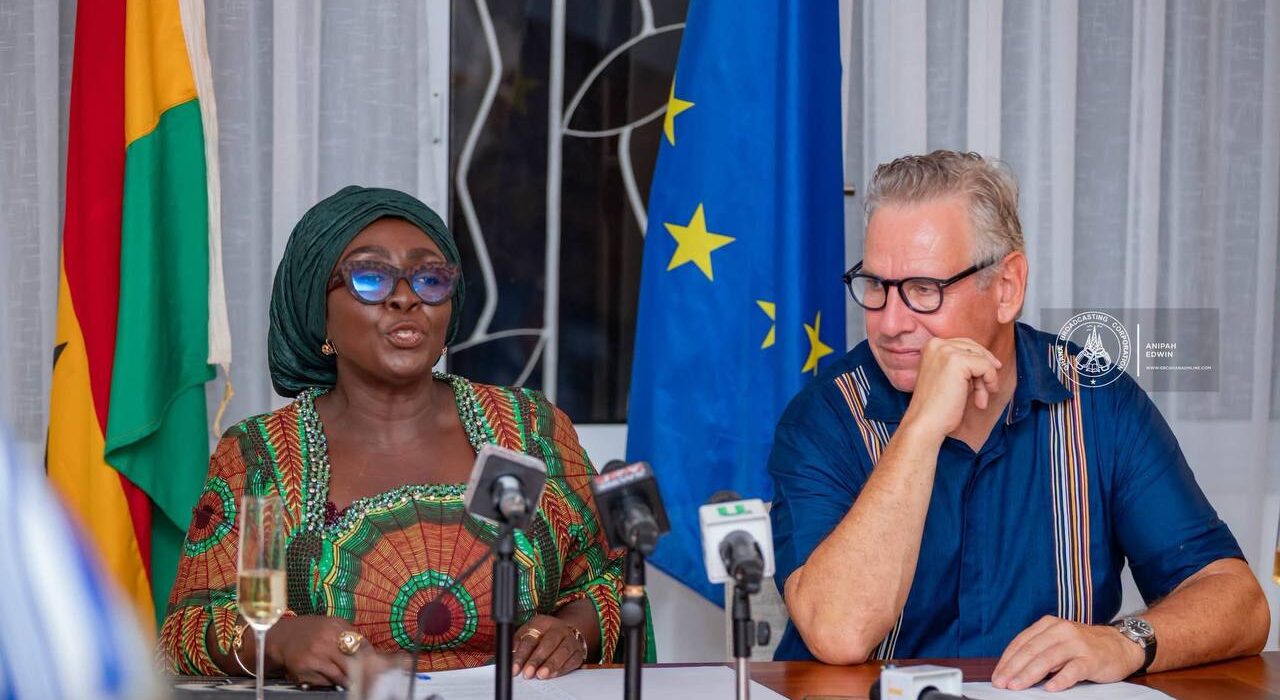
The Minister for Tourism, Culture and Creative Arts, Abla Dzifa Gomashie, has credited the European Union Delegation in Ghana for its support to the Ministry and stakeholders in revising Ghana’s cultural policy, describing the partnership as a significant contribution to strengthening the country’s cultural and creative sector.
The revised National Cultural Policy, which updates Ghana’s 2004 cultural policy framework, was officially launched in June 2026 following an extensive review and stakeholder consultation process.
Speaking at the opening of the 2026 European Union Film Festival at the residence of the EU Ambassador to Ghana, Rune Skinnebach, the Minister highlighted the revised policy, the EU-backed Sankofa II project and the Film Festival as key examples of the European Union’s contribution to Ghana’s cultural and creative industries.
“A particularly significant example is the support provided by the European Union towards the revision of the cultural policy of Ghana. I deliberately brought one copy to show off. I’m showing off because it’s between the two of us that we’re able to pull this off,” she stated.
The EU supported the revision of Ghana’s 2004 National Cultural Policy from its early stages, with the EU and UNESCO providing funding for the review process. The process also involved consultations with stakeholders across Ghana’s cultural and creative sector, with digitalisation and technological advancement identified among the issues requiring greater attention in the revised framework.
The Minister also highlighted the Sankofa II project, a three-year, €2.5 million initiative being implemented by the EU and Expertise France to strengthen Ghana’s cultural heritage and creative industries.
The project focuses on improving the conservation and management of Ghana’s heritage while supporting innovation, skills development and professionalisation across the creative industries. It also provides opportunities for artists, creative entrepreneurs and cultural operators through training, networking and international mobility, while supporting the use of digital tools in heritage preservation.
Gomashie also pointed to the European Union Film Festival as another avenue through which the EU is supporting Ghana’s creative sector and strengthening cultural exchange between Ghana and Europe.
The 2026 European Union Film Festival themed “Peace, Tolerance and Inclusion,” will showcase films from Ghana and European Union member states, with 21 Ghanaian and European films scheduled to be screened.
Beyond the screenings, the festival features masterclasses in animation, creative development, costume and makeup, and representation, alongside a movie pitch competition giving emerging filmmakers an opportunity to develop and present their ideas.
The festival is aimed at using film and the wider creative industry to promote cultural exchange, diversity and dialogue between Europe and Ghana while creating opportunities for industry players to exchange knowledge, build connections and explore collaborations.
The EU’s support for the cultural policy review, Sankofa II and the Film Festival therefore forms part of a broader partnership focused on strengthening Ghana’s cultural ecosystem, supporting creative professionals and creating new opportunities for the country’s creative economy.
Related Posts