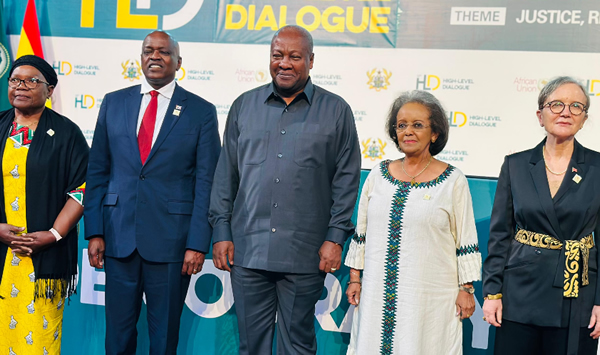
The African Union’s 13th High-Level Dialogue on Democracy, Human Rights, and Governance has officially opened in Accra, uniting voices across the continent to advance the 2025 theme: “Justice, Rights, Reparations and State Building.”
Hosted under the auspices of the African Governance Architecture and Peace and Security Architecture (AGA-APSA), the Dialogue has drawn AU member states, civil society, academics, and private sector actors into open and inclusive discussions on Africa’s democratic future.
The High-Level Dialogue (HLD), a flagship AU initiative, provides a platform for frank conversation on policy reforms and practical strategies that promote good governance, human rights, and inclusive development.
This year’s gathering in Accra comes at a defining moment in the continent’s quest for reparative justice and political accountability, amid growing calls to redress historical injustices and build resilient states grounded in dignity and fairness.
The AU has committed to transforming the 2025 theme into a continental roadmap with measurable goals, including building strategic partnerships with UN agencies and addressing the legal hurdles that stall restitution and reparations processes.
It further aims to consolidate momentum from past efforts and foster deeper engagement among AU member states, Regional Economic Communities (RECs), AU organs, and international partners.
President John Dramani Mahama, opening the conference, called for a renewed continental resolve to move beyond rhetoric and into meaningful, actionable change.
“We gather here not only to examine our painful past, but to shape a different and better future for our continent, where African agency, sovereignty, and dignity are restored and respected,” he said.
President Mahama commended the African Union Executive Council for declaring 2026 to 2036 as the Decade of Reparations, and for approving the terms of reference for two key bodies: the AU Commission of Experts on Reparations and the AU Reference Group of Legal Experts on Reparations.
He said, “These are critical milestones, but we must now move swiftly to personalise these instruments…Let this not be another declaration left on paper. Let it be a living mandate for action.”
The President made a strong case for civic and political education as a pillar of state building.
He urged the AU to push for legally binding frameworks to safeguard civic spaces and freedoms across member states, stressing that “democracy cannot thrive in the presence of fear or repression.”
AU Commission Chairperson Mr. Mahmoud Ali Youssouf, in a speech delivered on his behalf by Ambassador Bankole, AU Commissioner for Political Affairs, Peace and Security, reiterated the sentiment that justice, peace, and reparations are fundamental to Africa’s transformation.
“Reparations are not isolated from justice and collective rights,” he stated, and that, “they provide the foundation for true reconciliation and healing…for economic advancement, democratic renewal, and sustainable peace”.
The AU Chairperson emphasized that Africa must confront the legacy of slavery, colonialism, and cultural theft by translating historical grievances into future-oriented state-building policies.
Mr Youssouf acknowledged that despite progress, global efforts to redress crimes such as slavery and colonization by the AU, it hd often faced strong resistance and a lack of political will.
Recent developments such as the partial return of cultural artefacts from France to Benin highlight both the potential and limitations of global restitution debates.
Mr Samuel Okudzeto Ablakwa, Ghana’s Minister for Foreign Affairs, expressed excitement in hosting the landmark event and reaffirmed Ghana’s longstanding commitment to the values of justice and reparations.
He said, “This dialogue serves to advance the core principles of democracy while ensuring that justice, dignity, and inclusion are upheld,” he said.
The Foreign Minster stated that “Restorative justice must move beyond rhetorical distance and manifest as a tangible reality for all.”
He lauded the AU’s Political Affairs, Peace, and Security Department for convening the forum and praised the active participation of women and youth in the pre-dialogue sessions.
Source: GNA
Related Posts