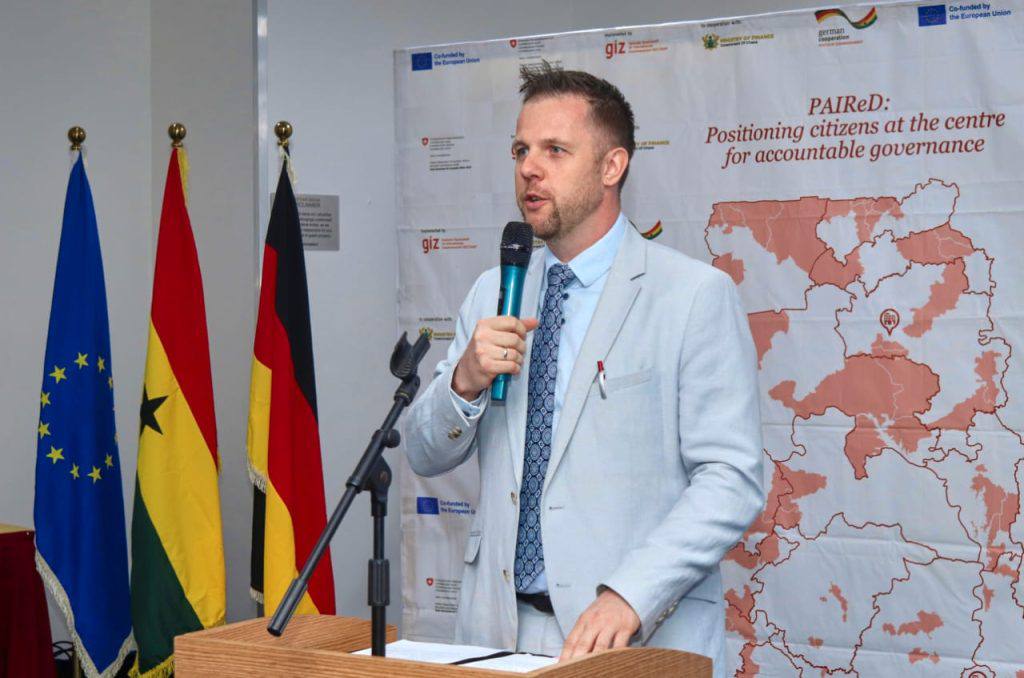
The Deputy Ambassador of the European Union to Ghana, Jonas Claes, has commended the government’s efforts to combat illegal mining, describing the revocation of legislation facilitating mining in forest reserves and the establishment of NAIMOS as important steps towards addressing the menace.
He made the remarks at the public launch of three baseline studies under the €3 million EU-funded Gold for Good (G4G) project, which examined security coordination, compliance within the artisanal and small-scale mining (ASM) sector, and the environmental, health and rehabilitation challenges associated with mining activities.
Mr Claes identified the revocation of L.I. 2462, which granted the President discretionary powers to approve mining in globally significant biodiversity areas within forest reserves, and the establishment of the National Anti-Illegal Mining Operations Secretariat (NAIMOS) as significant measures in tackling illegal mining.
“Ghana has taken important steps to get this wicked problem under control, including the revocation of the Legislative Instrument which facilitated mining in forest reserves, and the establishment of the National Anti-Illegal Mining Operations Secretariat (NAIMOS). We commend the government on these important steps forward,” he said.
The National Anti-Illegal Mining Operations Secretariat (NAIMOS) recorded 738 operational activities between June 13 and September 30, 2026, covering approximately 50,662 kilometres, according to its Director of Operations, Colonel Kwame Sam Appiah.
The operations resulted in the destruction of 1,970 changfan machines and 863 makeshift structures, while 74 firearms and 551 rounds of ammunition were recovered
Also, the government’s revocation of L.I. 2462, which previously allowed mining in forest reserves under certain conditions, took effect on December 10, 2025, following the passage of the required 21 sitting days in Parliament.
The replacement instrument, L.I. 2501, prohibits mining in forest reserves, reinforcing the government’s commitment to protecting the country’s environmentally sensitive areas.
He, however, stressed that the effectiveness of these interventions would ultimately be measured by their impact on illegal mining activities and the quality of Ghana’s water bodies and food produce.
“Progress will ultimately be evaluated, however, on the curbing of galamsey activity, and—above all—the quality of Ghana’s water bodies and food produce,” he added.
The three baseline studies, launched under the Gold for Good project, highlight persistent governance, regulatory compliance, environmental and public health challenges within the artisanal and small-scale mining sector in the Savannah Region.
The findings indicate that only 2.92% of respondents involved in the study held mining licences, while approximately 74% were unaware of the regulations governing mining in their respective areas.
The studies also highlighted concerns over exposure to heavy metals, including cadmium, with women and children identified as particularly vulnerable groups. The findings underscore the need for stronger environmental monitoring, public health interventions and improved compliance within mining communities.
Gold for Good, formally known as Inclusive Growth and Stability through Responsible Artisanal and Small-Scale Mining in Ghana, is an 18-month, €3 million pilot initiative funded by the European Union under its NDICI Crisis Response Pillar and implemented by Coginta.
The initiative is being implemented in West Gonja Municipality, Bole District and Sawla-Tuna-Kalba District in the Savannah Region, where artisanal and small-scale mining provides livelihoods but has also raised concerns over environmental degradation, regulatory compliance and security.
Through the project, the EU and Coginta are seeking to improve oversight of artisanal and small-scale mining, support miners to meet GoldBod requirements, strengthen coordination among security and regulatory agencies and promote responsible gold sourcing. It also includes efforts to prevent mining-related conflicts and rehabilitate degraded mining sites.
The EU’s support comes amid growing concerns over the environmental and public health consequences of illegal mining, particularly the pollution of water bodies and destruction of forest reserves.
The initiative reflects the EU’s broader support for environmental protection and sustainable development in Ghana, while seeking to address the governance and livelihood challenges that make illegal mining difficult to contain.
Related Posts