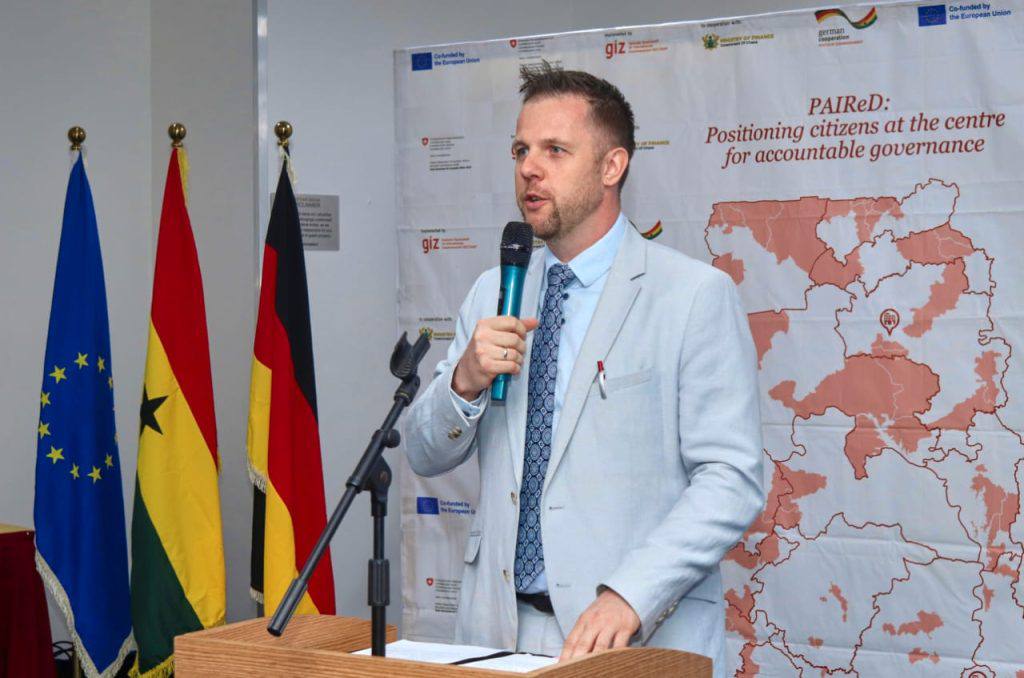
The Deputy Ambassador of the European Union to Ghana, Jonas Claes, has declared that the EU is no longer “idle” in the fight against illegal mining, noting that the menace threatens the wellbeing of Ghanaians and undermines the bloc’s economic interests and partnership with Ghana.
He made the remarks at the launch of three baseline studies under the €3 million EU-funded Gold for Good project, which examined security coordination, the socio-economic profile of artisanal and small-scale miners and their compliance with GoldBod requirements, as well as the environmental and health risks associated with mining activities.
Mr Claes acknowledged that the EU Delegation and its member states had largely stayed away from the illegal mining issues for the past three to four years, describing it as politically sensitive and complex. He, however, said the consequences of galamsey had made continued disengagement untenable.
“Three to four years ago, the European Union did not have any engagement in this field. It was considered politically risky, too complex of a problem. However, illegal mining is not only detrimental to the people of Ghana, it also directly undermines EU interests and the EU-Ghana Partnership,” he stated.
He cited the impact of illegal mining on public health, water sanitation, sustainable agriculture and forest conservation, areas in which the EU commits substantial development funding to Ghana.
“The EU spends sizeable programming funds towards sustainable agriculture, water sanitation, security and forestation, all of which are gravely undermined by illegal mining practices. For that reason, the European Union, and several of its member states, are no longer idle on the topic, but have several relevant engagements on the topic,” he said.
Mr Claes further linked the environmental consequences of illegal mining to Ghana’s export prospects, particularly its agricultural products entering the European market, which remains a major destination for the country’s non-traditional exports.
Eurostat data show that EU imports of goods from Ghana rose to approximately €3.74 billion in 2025, from €3.04 billion in 2024, representing an increase of 23.2%. The figures cover merchandise trade across sectors and are not limited to agricultural products.
Ghana’s non-traditional export sector also recorded strong growth in 2025, earning US$5.006 billion, a 30.7 per cent increase from the US$3.83 billion recorded in 2024, according to the Ghana Export Promotion Authority (GEPA).
The EU’s environmental requirements for agricultural imports are also becoming increasingly important for Ghanaian exporters, particularly those in the cocoa sector.
The EU Deforestation Regulation (EUDR), which is scheduled to apply from December 30, 2026, to large and medium-sized operators, requires covered products, including cocoa, to be traceable to their production plots and demonstrated to be free from deforestation and forest degradation after December 31, 2020.
Although the regulation is not a direct ban on Ghanaian agricultural products, exporters and supply-chain operators will need to meet its traceability and due-diligence requirements to maintain access to the EU market.
Illegal mining, particularly where it contributes to forest destruction, land degradation and water pollution, therefore presents an additional challenge to Ghana’s efforts to sustain environmentally compliant agricultural production and protect its export competitiveness.
Mr Claes said the EU and its member states were responding through a range of interventions, including the Gold for Good project, implemented by Coginta, and applied research initiatives by the Spanish Embassy examining illegal mining in the Ashanti and Western regions.
Gold for Good, formally known as Inclusive Growth and Stability through Responsible Artisanal and Small-Scale Mining in Ghana, is an 18-month, €3 million pilot initiative funded by the European Union under its NDICI Crisis Response Pillar.
The initiative is being implemented in West Gonja Municipality, Bole District and Sawla-Tuna-Kalba District in the Savannah Region, where artisanal and small-scale mining provides livelihoods but has also raised concerns over environmental degradation, regulatory compliance and security.
The project seeks to strengthen governance and coordination among security and regulatory agencies, support miners to formalise their operations and comply with GoldBod requirements, improve responsible gold sourcing, and promote environmental rehabilitation and social cohesion in mining communities.
Its activities include security and environmental risk assessments, joint training and coordinated field operations, socio-economic profiling of miners, compliance mapping and pilot rehabilitation of degraded mining sites.
The EU Delegation is also supporting Ghana’s efforts through its security and defence cooperation initiatives, which seek to strengthen the operational capacity of relevant security institutions, including NAIMOS, in tackling illegal mining.
The broader support includes capacity-building for security and civilian personnel, improved coordination among key stakeholders and assistance for enforcement operations, with the ultimate objective of promoting a mining sector that is law-abiding, environmentally sustainable, socially inclusive and economically beneficial to mining communities.
Related Posts