

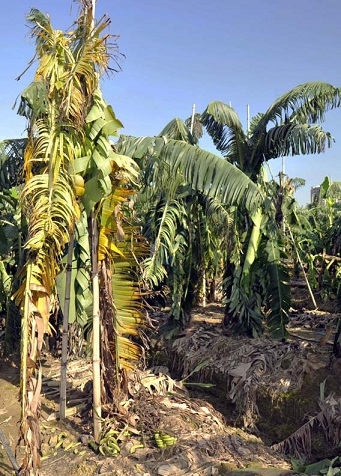
 The Food and Agriculture Organization of the United Nations (FAO) is warning countries to step up monitoring, reporting and prevention of one of the world’s most destructive banana diseases, known as “Fusarium wilt (TR4)”.
An information brief released by FAO and copied to Diplomatic Call reveals that “the disease which is also known as the Panama disease is posing a serious threat to production and export of the popular fruit, [which could have] serious repercussions on the banana value chain and livelihoods”.
According to the statement, the Fusarium wilt (TR4) has recently spread from Asia to Africa and the Middle East and has the potential to affect countries in Latin America if appropriate measures are not taken to control it.
The Fusarium wilt (TR4) is caused by the fungus Fusarium oxysporum f.sp. cubense (Foc). The disease is soil-borne and the fungus can remain viable for decades.
Even though the fungi disease cannot be fully controlled by currently available practices and fungicides, it could be stopped by preventing its spread, which includes avoiding movement of diseased plant materials and infected soil particles.
The FAO recognizes an urgent need to resolve the renewed threat to the banana crop, which according to FAOSTAT, is the eighth most important food crop in the world and the fourth most important food crop among the least-developed countries.
The Secretary of the World Banana Forum, a forum dedicated to promoting sustainable banana production and trade further, Mr. Gianluca Gondolini explained that “any disease or constraint that affects bananas is striking at an important source of food, livelihoods, employment and government revenues in many tropical countries.”
Mr. Fazil Dusunceli, a plant pathologist at FAO, reiterated Mr. Gondolini’s call to action stressing that “the spread of Fusarium wilt banana disease could have a significant impact on growers, traders and families who depend on the banana industry” adding that, “countries need to act now if we are to avoid the worst-case scenario, which is massive destruction of much of the world’s banana crop.”
The FAO is therefore calling for a concerted effort from stakeholders including the industry, research institutions, governments and international organizations, aimed at fighting the Fusarium wilt (TR4) disease by creating awareness at all levels and encouraging the adoption of appropriate risk assessment, surveillance and early warning systems.
The FAO is also urging countries to implement phytosanitary and preventive measures such as agricultural practices including quarantines, the use of disease-free planting materials, prevention of movement of infected soil, planting materials into and out of farms, and disinfection of vehicles, in order to prevent the spread of the disease.
“We need to raise awareness of this threat, coordinate efforts among countries and institutions for effective implementation of appropriate quarantine measures, and also work with banana producers, traders, plantation employees and smallholder farmers to help to minimize the spread of the disease,” said Mr. Dusunceli.
The TR4 has caused significant losses in banana plantations in Southeast Asia over the last two decades, and has recently been reported in Mozambique and Jordan.
TR4 infects the Cavendish banana varieties, which dominate global trade, as well as other susceptible varieties used for local consumption and markets. Despite damage to the banana plant and to production, the fruit itself remains edible.
FAO and its partners, including the World Banana Forum (WBF), the scientific community and the banana industry are among those making efforts to increase awareness of the inherent threat of TR4.
Efforts aimed at addressing the Fusarium wilt (TR4) and its related issues will be further discussed at a series of upcoming FAO meetings in Kenya, South Africa, and Trinidad and Tobago.
By Prince Asare, Diplomatic Call
Related Posts