
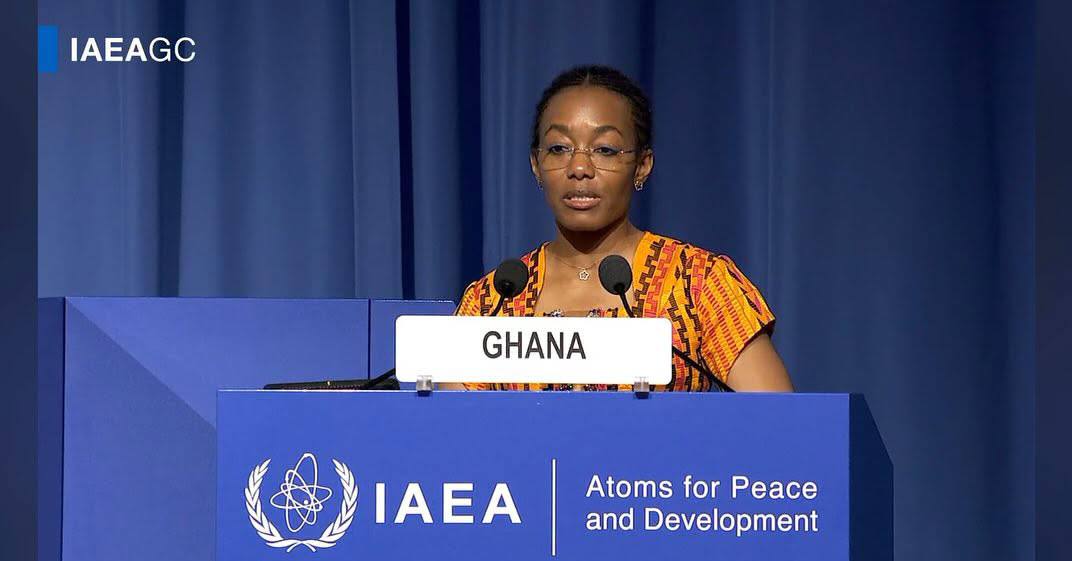
Mr. President, Director-General of the IAEA, Excellencies, Distinguished Delegates, Ladies and Gentlemen, Ghana warmly congratulates you, Mr. President, on your election and assures you of our full support throughout this Conference. We also commend the Director General and the Secretariat for their steadfast leadership in advancing the peaceful uses of nuclear science and technology.
Amid growing challenges to global multilateralism, peace and security, the IAEA’s work is more relevant than ever. On behalf of the Republic of Ghana, I also wish to congratulate TimorLeste on its membership of the IAEA.
For Ghana, the Agency remains an indispensable partner in harnessing nuclear science for socio-economic development. We value its sustained support in energy, health, agriculture, industry, water resources management, environmental protection and sustainability, climate resilience, nuclear safety and security, and human-resource development.
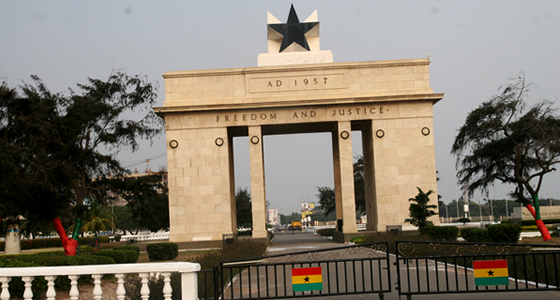
It is therefore befitting to highlight that as we mark the 70th General Conference, a notable milestone since the IAEA was founded in 1957 – a year that also holds profound significance for Ghana as the year of our independence – we are being provided with an important opportunity to consolidate the gains achieved by the Agency for our collective benefit.
Mr. President, Ghana’s nuclear power programme continues to make steady progress. Over the past year, significant advances have been made in site characterization activities, including the installation of meteorological monitoring systems at both preferred and alternative sites.
Geographic Information System (GIS)-based verification exercises, supported by aeromagnetic survey data, have enhanced our understanding of subsurface conditions, while ongoing land acquisition processes are helping to position the country for the next phase of development.
These milestones are not merely technical achievements. They represent Ghana’s deliberate and responsible approach to building a future powered by reliable, clean, and sustainable energy.
At the heart of this journey is human capital. Through strategic partnerships with the IAEA, the European Union and countries including the United States, China, Japan, the Republic of Korea, and the Russian Federation, Ghana is building the skilled workforce required to support a modern nuclear industry.
This commitment was further demonstrated through Ghana’s successful hosting of the recently concluded United States-Africa Nuclear Energy Summit (USANES) under the theme “Building and Sustaining Africa’s Nuclear Workforce.” The Summit highlighted a shared continental ambition: to ensure that Africa is jot merely a beneficiary of nuclear technology but an active contributor to its future development.
Mr. President, this year marks a significant milestone for Ghana as the School of Nuclear and Allied Sciences (SNAS), established through a partnership between the Ghana Atomic Energy Commission (GAEC), the University of Ghana, and the IAEA, celebrates 20 years of excellence in graduate nuclear education. Since inception, over 800 master’s and PhD graduates in various nuclear disciplines have emerged from the School, many of whom now serve in senior positions in Ghana and across Africa.
Furthermore, the MPhil programme in Applied Human Nutrition and Nuclear Techniques has commenced, while the MPhil in Radiation and Cancer Biology is scheduled to commence next academic year. These programmes are strengthening Ghana’s scientific leadership and capacity across Africa.
Mr. President, In the field of nuclear medicine: cancer remains one of the most pressing public health challenges facing our continent. Ghana is therefore working closely with the IAEA and international partners to strengthen cancer prevention, diagnosis, treatment, and care.
The Integrated Mission of the Programme of Action for Cancer Therapy (ImPACT) conducted earlier this year provided valuable guidance for improving national cancer control and mobilizing partnerships for sustainable investment.
Additionally, Ghana appreciates the IAEA’s continued support through the regional breast-cancer imaging course and the Quality Assurance Audit for Diagnostic Radiology Improvement and Learning (QUAADRIL) mission hosted in 2025, which provided valuable recommendations to strengthen diagnostic radiology services.
Ghana also sincerely appreciates the mammography machine awarded under the Rays of Hope initiative, made possible through Japan’s generous contribution. This support will enhance early breast-cancer detection, improve access to timely care, and contribute to better health outcomes and saving lives.
Mr. President, Nuclear and isotopic techniques are helping Ghana address nutrition challenges. The DEXA scanner has been acquired under the IAEA-supported RAF6059 Project.
Combined with stable-isotope methodologies, these tools are advancing research and informing effective public health policies. Nuclear applications are also supporting Ghana’s agricultural transformation. Through Technical Cooperation Project GHA5040, Ghana is strengthening capacities in soil, water and nutrient management, mutation breeding, animal production and health, food safety and human nutrition.
Demonstration farms, farmer field schools and digital platforms will translate research into practical benefits, contributing to food security, productivity, employment and resilient livelihoods.
Mr. President, In environmental sustainability, nuclear and isotopic techniques provide critical scientific evidence for policy and decision-making. Ghana’s Isotope Hydrology Laboratory supports research on groundwater systems, water quality and basin dynamics.
Our participation in regional efforts to harmonize microplastics monitoring is enhancing laboratory capacity and scientific cooperation to protect marine ecosystems and coastal communities. As climate pressures intensify, these capabilities will be vital for water security and environmental sustainability.
In industrial applications, Ghana has completed a feasibility study for an electron-beam processing facility and developed a project document to mobilise national and private-sector investment. The Government has committed seed capital to the initiative. The facility could promote safer industrial processing, innovation, investment and new economic opportunities.
Mr. President, a strong nuclear programme must be underpinned by a strong culture of safety and security. Ghana remains committed to strengthening its regulatory framework through continuous improvement, international cooperation, and implementation of recommendations from the Integrated Regulatory Review Service mission.
Participation in the Tenth Review Meeting of the Convention on Nuclear Safety, together with ongoing work on emergency preparedness and periodic safety reviews, demonstrates this commitment. Ghana is also strengthening its nuclear security architecture.
Preparations are underway to host the International Physical Protection Advisory Service (IPPAS) and International Nuclear Security Advisory Service (INSServ) missions in 2027.
Ghana has also subscribed to INFCIRC/908 on insider threat mitigation and remains an active contributor to the IAEA Nuclear Security Guidance Committee.
With support from the United States National Nuclear Security Administration, upgrades have strengthened physical protection at key facilities, ensuring that nuclear and radioactive materials remain secure and exclusively dedicated to peaceful purposes.
Mr. President, Ghana’s nuclear journey is about innovation, resilience, advancement in healthcare, food and water security, sustainable energy, building human capital and cooperation.
As a country that is fully cognisant of its demographic dividend, Ghana remains fully committed to the safe, secure and peaceful use of nucleartechnology towards sustainable development. We hold dear our duty to protect and preserve our environment for posterity.
Together, let us make the atom a force for development, peace, hope and a better future in honour of our 70th annual session and beyond.I thank you.
Related Posts