
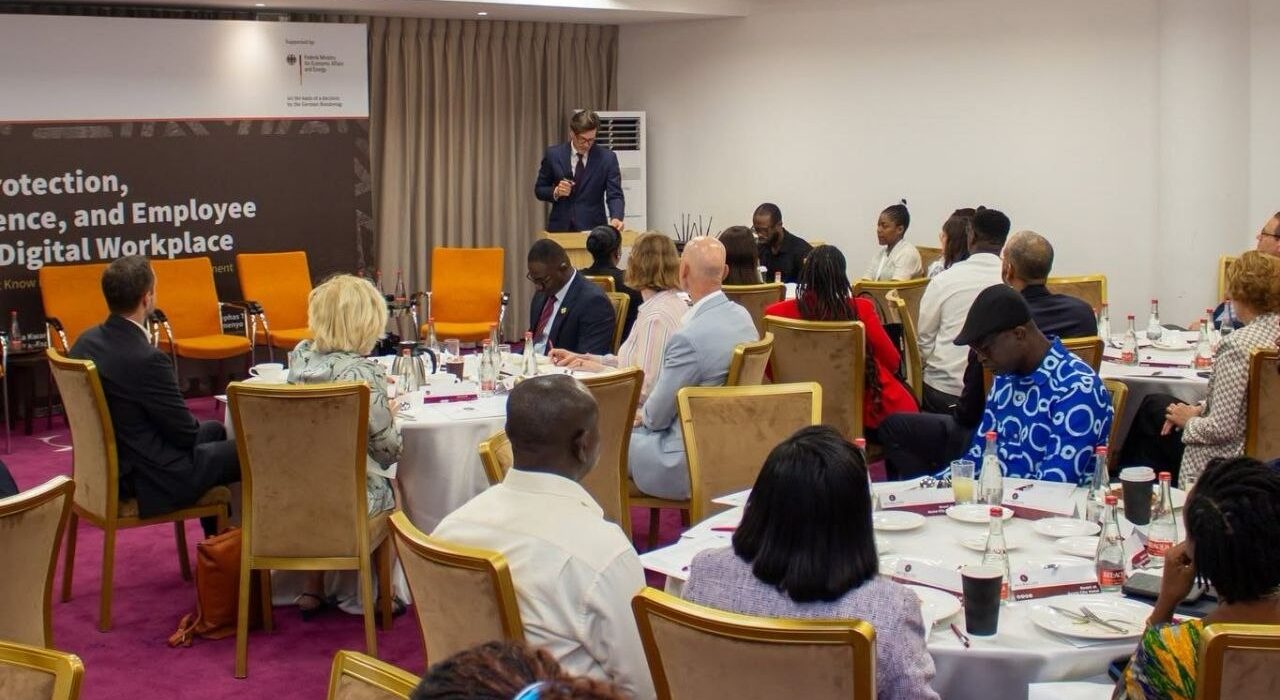
The Ambassador of Germany to Ghana, Frederik Landshöft, has highlighted the German Federal Foreign Office’s growing adoption of artificial intelligence (AI) to improve the delivery of services and support the work of its diplomatic missions worldwide.
He made the remarks at the Premium Partners Executive Breakfast organised by the Delegation of German Industry and Commerce in Ghana (AHK Ghana), which brought together business leaders, policymakers and legal experts to examine the implications of AI for the future of work.
The discussions focused on the rapid integration of AI into workplaces and the opportunities and challenges the technology presents for businesses, governments and employees. Participants explored how organisations can adopt emerging technologies while maintaining appropriate safeguards, accountability and public confidence.
Germany has experienced a sharp increase in the use of AI across its economy. According to the latest survey by the ifo Institute, 54.5% of German companies were using AI in their business processes as of May 2026, up from 40.9% a year earlier. Adoption was particularly high in manufacturing at 58.7% and services at 56.2%, with companies using AI mainly in administration, data analysis, programming, correspondence and information research.
The German Federal Foreign Office is also integrating AI into its operations as part of efforts to improve efficiency and strengthen its capacity to manage large volumes of information and public enquiries. One example is FACIL, an AI-supported system that has been used since 2021 to process and respond to millions of enquiries received by the Foreign Office, including questions relating to travel and security information and visa requirements. The system is now used at the ministry’s headquarters as well as at 38 German missions abroad.
The Foreign Office has also developed PLAIN, a secure AI-enabled platform that allows federal government employees to analyse large volumes of data and use tools such as chatbots and automated text summarisation. In June 2026, the ministry adopted an AI Charter setting out principles for the responsible and effective use of artificial intelligence, emphasising that AI should support human decision-making rather than replace it.
The German approach reflects a wider European effort to balance technological innovation with safeguards for workers and fundamental rights. Under the European Union’s AI Act, certain AI applications used in employment and worker management are classified as high-risk because of their potential impact on fundamental rights. The framework is designed to impose stronger requirements on such systems, particularly where AI is used in sensitive areas of employment.
The EU has also prohibited certain uses of AI considered to pose unacceptable risks, while requiring safeguards for high-risk applications. The European Commission’s framework places emphasis on human oversight, accountability and the protection of fundamental rights as AI becomes increasingly embedded in professional and workplace decision-making. Following a 2026 agreement to adjust the implementation timetable, the rules for high-risk AI systems in areas including employment are scheduled to apply from December 2, 2027.
The growing adoption of AI is also reshaping discussions around skills and employment in Germany. A separate June 2026 survey by the ifo Institute found that nearly 20% of companies already using AI considered it easy or very easy to replace workers with formal qualifications with workers without such qualifications but supported by AI, while about 15 per cent said the same about replacing experienced workers with less experienced employees using AI.
Against this backdrop, the discussions at the Premium Partners Executive Breakfast underscored the need for businesses to establish clear governance frameworks for AI adoption while ensuring that technological progress does not undermine individual rights or public trust. The engagement provided an opportunity for participants to examine how businesses in Ghana can prepare for changes in productivity, skills requirements and workplace organisation arising from the rapid development of AI.
AHK Ghana reaffirmed its commitment to supporting German businesses operating in Ghana by listening to their concerns, facilitating engagement with policymakers and other stakeholders, and helping identify opportunities for cooperation. The forum therefore served as a platform for dialogue on how businesses can navigate the evolving AI landscape while preparing for a future of work increasingly shaped by digital technologies.
Related Posts