
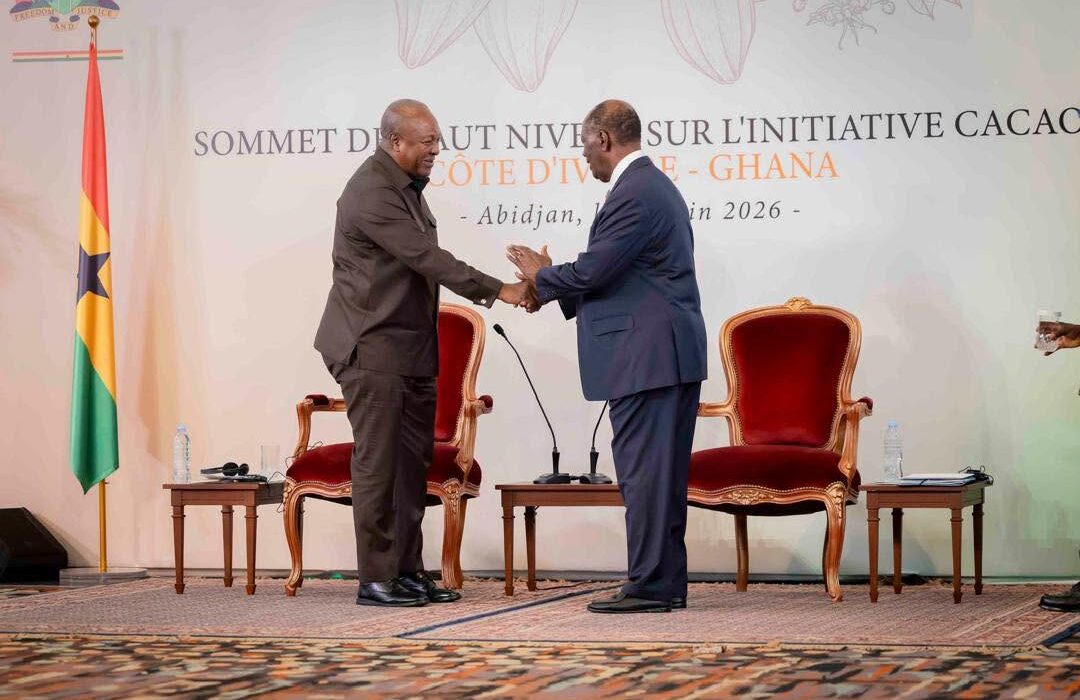
The world’s two largest cocoa-producing countries, Ghana and Côte d’Ivoire, have signed a joint declaration committing to process a greater proportion of their cocoa domestically before exporting to international markets, marking a significant shift in Africa’s approach to capturing value from its natural resources.
The agreement forms part of a package of five strategic measures adopted by President John Dramani Mahama and President Alassane Ouattara to advance the interests of cocoa-growing countries, improve livelihoods for smallholder farmers, and strengthen the contribution of the cocoa sector to their respective economies.
The two leaders underscored the need for Africa to retain a greater share of the value generated from its resources, noting that Ghana and Côte d’Ivoire, which together account for more than half of global cocoa production, have a special responsibility to lead the continent’s efforts towards value addition and industrialisation.
The commitment signals a departure from the long-standing practice of exporting raw cocoa beans for processing abroad, only for finished products to be imported back into African markets. By increasing local processing capacity and stimulating cocoa consumption within the African sub-region, both countries aim to transform themselves into competitive agro-industrial hubs while creating jobs and expanding domestic manufacturing.
A major outcome of the meeting was the reaffirmation of the Côte d’Ivoire–Ghana Cocoa Initiative (CIGCI), with both countries committing to deepen cooperation on price stability, environmental sustainability, farmer welfare, and industrialisation. The leaders also agreed to explore opening the initiative to other African cocoa-producing countries in order to strengthen the continent’s collective bargaining power within the global cocoa industry.
The engagement comes at a challenging period for the cocoa sector. Despite recent fluctuations in global cocoa prices, both countries continue to grapple with market volatility, production constraints, and sustainability concerns that have placed pressure on farmers, government revenues, and national cocoa marketing systems.
To cushion producers from external shocks, Ghana and Côte d’Ivoire reaffirmed their commitment to the Living Income Differential (LID) and agreed to further harmonise producer pricing mechanisms. The move is intended to ensure fair remuneration for farmers while reducing the risks associated with international market fluctuations through coordinated pricing and marketing strategies.
Under the joint declaration, both countries also agreed to implement a common framework for determining producer prices and strengthen market intelligence systems to improve transparency and fairness across the cocoa value chain. They further recognised the Côte d’Ivoire–Ghana Cocoa Initiative (CIGCI) and the African Regional Standards for Sustainable Cocoa (ARS-1000) as critical instruments for traceability, sustainability, and responsible cocoa production.
Environmental sustainability featured prominently in the discussions. Faced with increasing scrutiny under the European Union Deforestation Regulation, Ghana and Côte d’Ivoire pledged to intensify efforts to ensure cocoa production does not contribute to deforestation and environmental degradation. The leaders agreed to adopt a joint strategy to aggressively tackle illegal mining activities, undertake comprehensive clean-up operations of shared water bodies, and strengthen climate adaptation measures within cocoa-growing communities.
The two countries also committed to enhancing scientific collaboration between their national research institutions to combat the devastating Cocoa Swollen Shoot Virus Disease (CSSVD) and other pests and diseases that continue to threaten cocoa productivity. Strengthening research, disease surveillance, and the dissemination of improved planting materials were identified as key priorities.
The renewed commitment builds on the foundations of the Côte d’Ivoire–Ghana Cocoa Initiative (CIGCI), which emerged from the Abidjan Declaration in 2018. The initiative was established to jointly influence global cocoa pricing, improve producer incomes, harmonise sustainable production policies, and address challenges that transcend national borders.
At its core, the CIGCI seeks to enhance economic outcomes for cocoa farmers by strengthening the bargaining power of producing countries and creating a more stable and equitable framework for the global cocoa trade. The latest declaration signals a renewed determination by Ghana and Côte d’Ivoire to reshape the future of the cocoa industry—from one centred on raw commodity exports to one driven by value addition, industrialisation, and shared prosperity.
Related Posts