
India is set to establish an AYUSH Chair at the University of Health and Allied Sciences (UHAS) to serve as a hub for collaborative research, education and capacity building in traditional medicine between Ghana and India.
The proposed Chair is expected to provide a dedicated platform for students and faculty to undertake joint research while strengthening institutional capacity in areas including quality assurance and regulatory frameworks for traditional medicine.
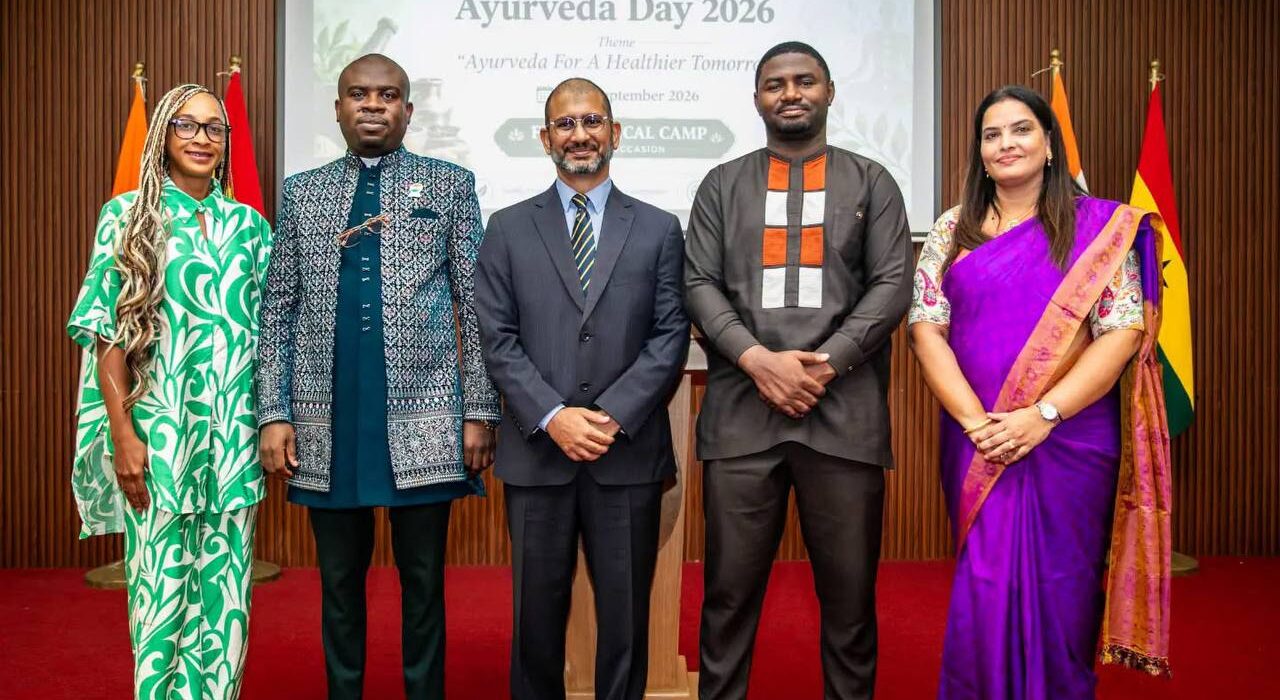
The announcement was made by the Indian High Commissioner to Ghana, Surinder Bhagat, during an Ayurveda Day celebration hosted by the High Commission of India in Accra.
The event brought together stakeholders from Ghana’s traditional and alternative medicine sector, including representatives of the Traditional Medicine Practice Council, the Ghana Alternative Medical Practitioners Association, practitioners, academics and other members of the Ayurveda and traditional medicine community.
The establishment of the Chair builds on the institutional cooperation established during Indian Prime Minister Narendra Modi’s official visit to Ghana in July 2025, when Ghana and India elevated their bilateral relationship to a Comprehensive Partnership.
During the visit, the two countries exchanged four Memoranda of Understanding, including an agreement between UHAS’s Institute of Traditional and Alternative Medicine (ITAM) and India’s Institute of Teaching and Research in Ayurveda (ITRA), an autonomous institution under the Ministry of AYUSH.
The ITAM–ITRA agreement provides a framework for cooperation in traditional medicine education, training and research which is intended to advance Ayurveda education, research, clinical training and institutional capacity building.
The proposed AYUSH Chair represents a further step from the bilateral agreement towards a more structured academic relationship. Rather than serving solely as an academic position, the Chair is expected to provide a platform through which researchers, lecturers and students can work across the two knowledge systems and develop research and institutional capacity.
Describing the proposed Chair, the Indian High Commissioner, Shri Surinder Bhagat said it would be a “living bridge” between the traditional medicine knowledge systems of Ghana and India.
“This AYUSH Chair will be more than just an academic post. It will be a living bridge between our two knowledge systems. This chair will function as a dedicated nucleus for collaborative research, fostering an environment where students and faculty can engage in joint research, while systematically building institutional capacity in quality assurance and regulatory frameworks.” he stated
The initiative comes as India continues to develop a formal institutional framework around its traditional systems of medicine. The Government of India established the Ministry of AYUSH as a full-fledged ministry on November 9, 2014, after the earlier Department of AYUSH, which had been responsible for the development and propagation of Indian traditional medicine systems.
AYUSH covers Ayurveda, Yoga and Naturopathy, Unani, Siddha and Homoeopathy, with the Indian government’s policy framework placing emphasis on education, research, development, regulation and the wider integration and promotion of these systems.
India has also increasingly placed scientific research, quality, safety and regulatory systems at the centre of its international traditional-medicine cooperation. Its Ministry of AYUSH maintains research institutions and programmes covering the different traditional systems and has promoted international collaboration in education, research, standards and healthcare delivery.
The Ghana–India cooperation comes against the background of the two countries’ decision in July 2025 to elevate their relationship to a Comprehensive Partnership. The agreement covers a broad range of areas, including trade and investment, agriculture, digital technology, infrastructure, health, capacity building and people-to-people relations.
The traditional medicine component has since developed into a wider programme of institutional and sectoral engagement. UHAS and India’s ITRA have already established a formal academic framework for cooperation, while the proposed AYUSH Chair is intended to provide a permanent focal point for deeper collaboration in research and capacity development.
For Ghana, the initiative could provide an additional platform for research into traditional medicine and for developing stronger systems around quality assurance, regulation and evidence-based practice. For India, it extends the country’s international cooperation in AYUSH and traditional medicine into a Ghanaian academic institution.
The initiative is therefore being positioned as part of broader South-South cooperation, using the two countries’ respective traditional medicine knowledge systems as a basis for academic exchange, research and institutional development.
Related Posts