
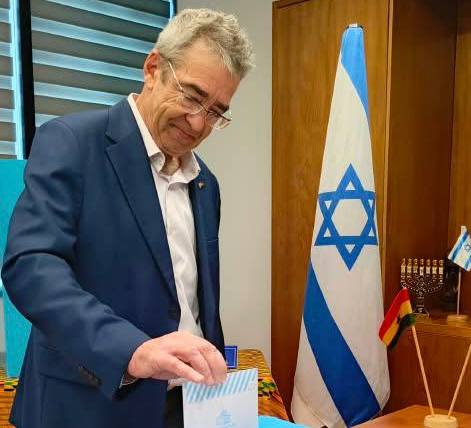
Israeli Ambassador to Ghana Roey Gilad and staff of the Israeli Embassy in Accra have cast their ballots ahead of Israel’s October 27 national elections, as the country prepares for a vote expected to shape its political leadership and approach to the conflicts confronting the Middle East.
The embassy staff joined Israeli diplomatic missions around the world in the overseas voting exercise, which began on October 15, allowing eligible Israeli officials serving abroad and members of their families to participate in the parliamentary elections.
According to Israel’s Ministry of Foreign Affairs, approximately 4,800 eligible voters are expected to cast ballots at 101 polling stations across 99 diplomatic missions worldwide. The overseas voting process precedes the main election scheduled for October 27.
The embassy described the exercise as an expression of Israel’s commitment to democratic values, emphasising the importance of enabling citizens representing the country abroad to participate in determining its political future.
“Their participation reflects Israel’s commitment to democratic values and ensures that citizens serving their country abroad remain actively involved in shaping its future,” the embassy stated.
Ambassador Gilad also highlighted what he described as a shared democratic foundation between Ghana and Israel, pointing to the importance of strong democratic institutions in both countries.
“This is one thing we share with Ghana. Two democracies that are leaning on strong democratic institutions,” he said.
The October 27 election will be Israel’s first national vote since the Hamas-led attacks of October 7, 2023, which triggered a prolonged conflict in Gaza and contributed to wider regional hostilities involving Lebanon and Iran.
The election is expected to test public confidence in Prime Minister Benjamin Netanyahu’s leadership, particularly over national security, the government’s handling of the October 7 attacks and the consequences of subsequent military campaigns.
Netanyahu’s right-wing coalition faces a challenge from opposition figures, including former military chief Gadi Eisenkot and former prime ministers Naftali Bennett and Yair Lapid. However, the outcome will depend not only on which party wins the most seats but also on the ability of competing political blocs to assemble a governing majority in the 120-seat Knesset, Israel’s parliament.
The stakes extend beyond domestic politics. Israel’s next government will face decisions over the future of the conflict with Iran, its military posture towards Hezbollah in Lebanon, the situation in Gaza and relations with Washington.
On October 14, Netanyahu said he was not in favour of launching a pre-emptive strike against Iran before the election, although he warned that Israel would respond forcefully if attacked. His remarks came amid renewed concerns about the possibility of further military confrontation between the two countries.
A change in government could alter Israel’s diplomatic priorities, its approach to negotiations and the influence of nationalist and religious parties over security and territorial policy. A continuation of the existing political bloc, meanwhile, could preserve much of the current government’s strategic direction, although coalition negotiations and domestic pressures would still shape policy.
The outcome will also be closely watched by the United States and regional governments, given Washington’s central role in Israel’s security and the potential consequences of renewed hostilities for regional stability, energy supplies and international diplomacy.
For Ghana and other countries maintaining diplomatic relations with Israel, the election could influence the political environment in which bilateral cooperation continues, including trade, technology, agriculture, security and development partnerships.
While the embassy’s overseas voting exercise highlights the participation of Israeli officials serving abroad, the wider significance of the October 27 poll will lie in the government that emerges and the choices it makes on security, diplomacy and the future of Israel’s relations with its neighbours.
Related Posts