
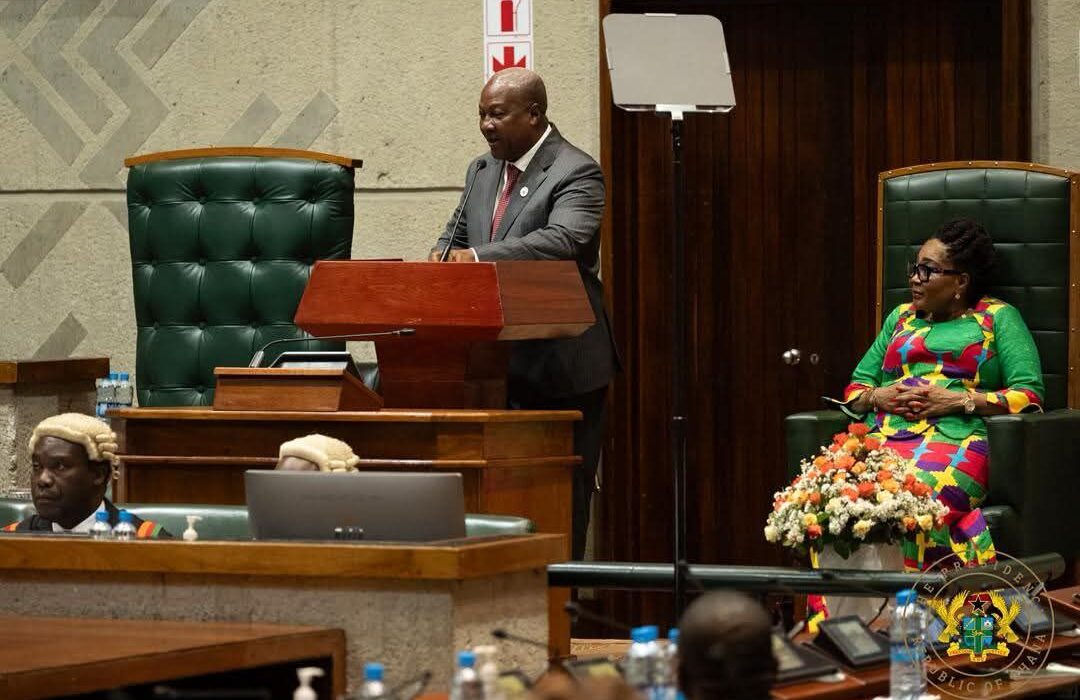
President John Dramani Mahama has called on African nations to reclaim control over their natural resources, warning that the continent will remain poor despite its vast wealth unless it breaks away from exploitative extractive arrangements that favour foreign interests over local development.
Addressing the broader legacy of colonial-era mineral agreements, Mahama argued that Africa’s role as a supplier of raw materials has denied its people lasting economic benefits. He urged governments to end concession models that allow international firms to profit from speculation while host countries retain only marginal returns, insisting that indigenous participation and value addition must become central to Africa’s development strategy.
“The era of parceling out large-scale concessions to speculators who then flip them for huge profits must end. We have the know-how; the technology and capital are available. Indigenous companies must be encouraged to participate in the extractive sector. We must support our indigenous private sector to capture the commanding heights of our economies.” Mahama asserted.
Using Ghana as a case study, President Mahama highlighted reforms aimed at reversing Africa’s historical role as a raw-material exporter. He noted that mining and the extractive sector play a critical role in Ghana’s economy, much like in Zambia and other African countries, yet limited value has traditionally been added locally despite the abundance of gold, bauxite, and manganese.
To change this narrative, Ghana established the Gold Board in April last year, granting it sole authority to regulate and export gold from the country. Since its establishment, gold exports from the artisanal and small-scale mining sector have increased from 63 metric tons to 104 metric tons within ten months, generating over US$10 billion in foreign exchange inflows.
“My country is changing that narrative. Ghana established the Gold Board in April last year to take control of and regulate gold exports. The Gold Board was given sole authority to export gold out of Ghana. Since the board’s establishment, gold exports from the artisanal and small-scale mining sector have increased from 63 tons to 104 tons over the past 10 months. This has earned Ghana over” he stated
President Mahama further revealed that Ghana is advancing local value addition by refining its minerals domestically. The Gold Board has signed an agreement with a local refinery to process approximately one metric ton of gold per week, replacing the export of raw doré gold. Similar efforts are underway to process manganese and bauxite locally, rather than exporting raw ores. Additionally, Ghana has replaced its flat-rate mineral royalty system with a sliding scale of 5% to 12%, tied to international market prices.
Africa’s resource wealth is vast but underleveraged. The continent holds an estimated 30 percent of the world’s mineral reserves, 12 percent of global oil reserves, and 8 percent of natural gas reserves. Africa also accounts for about 40 percent of global gold reserves, up to 90 percent of platinum, and roughly 65 percent of the world’s arable land, alongside immense forest and biodiversity resources.
Key mineral concentrations include gold in South Africa, Ghana, Tanzania, and Mali; diamonds in Botswana, the Democratic Republic of Congo, South Africa, and Angola; cobalt, vital for global battery production, largely in the Democratic Republic of Congo; platinum and chromium in South Africa; uranium in Namibia, Niger, and South Africa; copper in Zambia and the DRC; and bauxite in Guinea.
President Mahama stressed that Africa’s challenge is not a lack of resources, but the failure to control, process, and fully benefit from them, an imbalance he says must be corrected if the continent is to secure economic independence and a stronger position in the global order.
Related Posts