
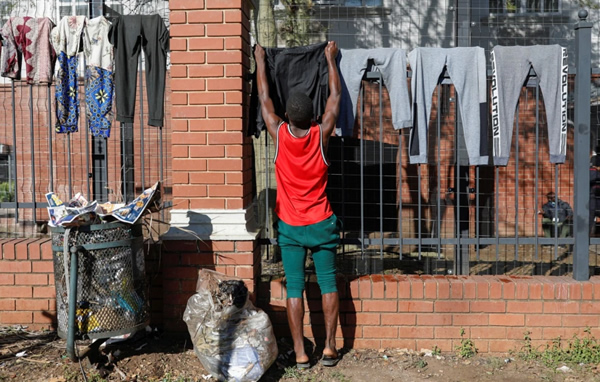
Dozens of refugees camped outside the United Nations refugee agency office say they have been living in South Africa for two decades, but now they no longer feel safe.
Most are from the Democratic Republic of Congo, where they escaped war.
But increasingly, they say they’ve had their small businesses looted, homes robbed and been personally attacked amid growing waves of xenophobia.
Lillian Nyota has been a refugee in South Africa since 2001.
“We ran away from our country, running from tribulations,” she said. “We came here in South Africa, we found more trouble, more tribulations. Because xenophobic attack is real, xenophobia is real, no one can deny it. It’s real.”
South Africa is home to more than 250,000 asylum seekers. Nyota’s group said they’ve moved from community to community, but violence eventually follows.
She said they’re now asking that the United Nations refugee agency move them to a safe third country.
“Any place that they can take us that way we can be safe with our families,” Nyota said. “We can live and move on with our lives so that our children can go to school.”
Xenophobic violence has become increasingly pronounced in South Africa with bursts of riots and murders since 2008.
Earlier this year, amid a wave of anti-migrant marches, a Zimbabwean man was killed in a Johannesburg township, authorities say because of his nationality.
Experts blame the problem on the country’s history of violence, socioeconomic issues and growing anti-foreigner politics.
Silindile Mlilo, a researcher at the University of Witwatersrand, said with xenophobic violence, there is usually no differentiation between refugees or asylum-seekers.
“If government is not seen as doing anything, it also discourages migrants and refugees who are in the country, because it’s like, is it safe for me?” Mlilo said.
Resettlement is not an option for most refugees.
The U.N. refugee agency, UNHCR, said only 1 percent of refugees globally are moved from one host country to another for exceptional circumstances.
Laura Padoan, spokesperson for UNHCR South Africa, said it’s only the most vulnerable refugees who are typically eligible for resettlement.
“That can be survivors of sexual or gender-based violence. It can be women and children at risk, people at risk because of their religious persecution,” Padoan said. “We really urge these refugees to take up the offer of local integration or repatriation, because no one wants to see people living out on the street.”
But these refugees outside her office maintain re-integration is not an option and say they will stay camped there until there’s a plan for them to leave South Africa.
Source: voanews.com
Related Posts