
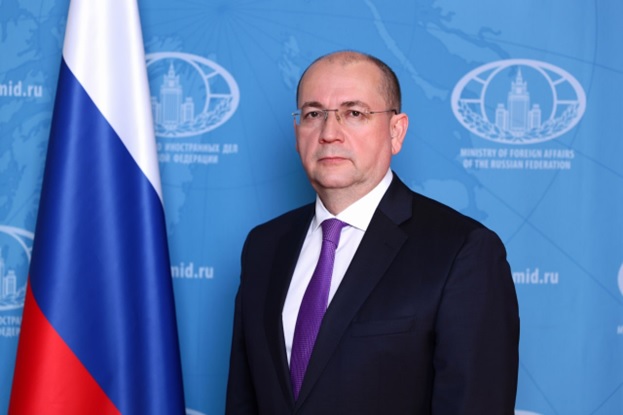
The Russian Ambassador to Ghana, Sergei Berdnikov, has told the Government of Ghana that the nationality of the individual allegedly involved in a non-consensual sex recording case still remains a puzzle as he is unable to confirm he is Russian.
He made this known after he was summoned by the Ministry of Foreign Affairs on 17 February 2026 over the viral alleged non-consensual sex recordings of Ghanaian women by an individual allegedly Russian under the social media name “Yaytseslav.”
The Ambassador also told the Ministry that the name which has led government officials, Ghanaian media, and the public to tag the individual as Russian, thereby drawing Moscow into the embarrassment, is not a Russian name but a vulgar expression in Russia.
“The Russian Ambassador, however, indicated that he is unable to confirm the Russian nationality of the individual at the centre of the intimate viral videos, and further disclosed that the purported name making the rounds in the media is not a known Russian name and rather represents an inappropriate or vulgar expression in the Russian language,” the statement read.
He stated that the saga has not only been reported by Ghanaians but that other countries have brought the case before Russian authorities, who have since opened an investigation.
This impacts Ghana’s efforts to bring the perpetrator to justice, as international legal remedies such as extradition from Russia are highly unlikely, given the absence of a bilateral agreement with Moscow. However, Ambassador Berdnikov pledged the Russian Embassy’s cooperation in sharing information to facilitate Ghana’s ongoing efforts to apprehend the individual and hold them accountable.
Earlier, while Speaking to journalists on February 14, Ghana’s Minister of Communication, Digital Technology and Innovations, Sam Nartey George emphasised that Ghana will use “every resource at our disposal,” including collaboration with Interpol, to trace the suspect’s whereabouts and ensure legal action if he fails to return. He also indicated that the Ministry would ensure the suspect is tried in absentia if he is not extradited to Ghana.
His statements are premised on the act violating Ghana’s digital privacy and cybercrime framework. Under the Cybersecurity Act, 2020 (Act 1038), the non‑consensual recording or distribution of intimate images or videos , whether involving adults or minors, is a criminal offence that carries severe penalties.
The Ministry of Gender, Children and Social Protection also weighed in, condemning the alleged acts as “digital sexual exploitation” and urging the public not to circulate the explicit content further, warning that doing so could itself constitute a criminal offence and cause additional trauma to the victims
The government has urged that sharing of the images of the ladies involved be restricted while it pursues every possible means to bring the perpertrator to book.
Related Posts