
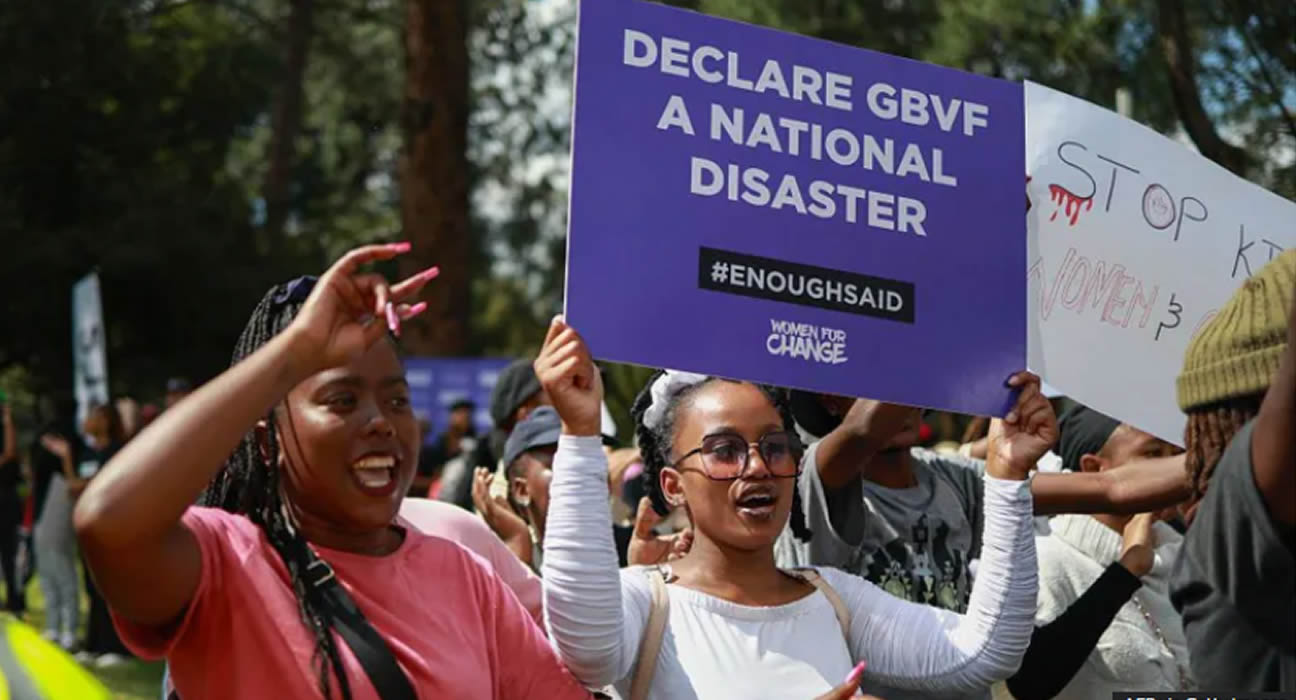
South African women’s rights groups are calling for nationwide protests to demand that gender-based violence (GBV) be declared a national disaster in a country where attacks on women have become commonplace.
The campaign began with a viral social media movement and will culminate in a nationwide “shutdown” on Friday, ahead of the G20 Summit in Johannesburg.
Celebrities, citizens and nations have shown their solidarity by changing their social media profile pictures to purple – a colour often linked to GBV awareness.
South Africa experiences some of the world’s highest levels of GBV, with the rate at which women are killed five times higher than the global average, according to UN Women.
Between January and March this year, 137 women were murdered and more than 1,000 raped, according to South African crime statistics.
Warning: This report contains descriptions of sexual assault
On Friday, women are being urged to refrain from going to work or school, “withdraw from the economy for one day”, and lie down for 15 minutes at 12:00 local time (10:00 GMT) in honour of the women murdered in the country.
They are also being urged to wear black as a sign of “mourning and resistance”.
The protest, dubbed the G20 Women’s Shutdown, has been organised by Women for Change, which has also been spearheading the online campaign.
There has also been an online petition, signed by over one million people, calling for the government to take an even tougher stance against the scourge.
The National Disaster Management Centre (NDMC) has rejected the calls to declare GBV a national disaster, saying it doesn’t fall within the legal requirements.
On Thursday, President Cyril Ramaphosa told the G20 Social Summit that South Africa had “declared gender-based violence and femicide a national crisis” in 2019.
However, activists say that little has changed and they want the government to take more action.
Women for Change spokesperson Cameron Kasambala lamented the enactment of “so many beautiful acts and legislations” over the years to try and tackle the issue, which are followed by “lack of implementation and transparency” on the government’s part.
“We’ve integrated violence… into our culture [and] into our social norms,” she told the BBC.
“Once the government truly reacts to this issue, I feel like we’ll already be able to see a reaction on the ground. Because they set the precedent and the tone for how the country responds,” she said.
Source: BBC
Related Posts