
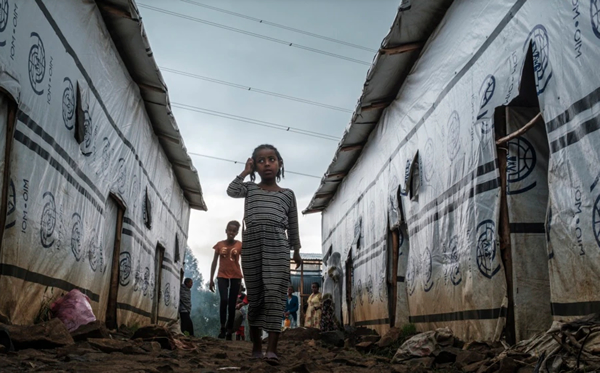
A total of 1.39 million children in the Tigray region are currently missing out on education because of Ethiopia’s civil war, according to the United Nations.
While journalists are banned from entering Tigray, VOA was able to access the neighboring Amhara region, where schools are beginning to reopen, after Tigrayan forces that occupied much of the region withdrew in December.
But the occupation left deep scars. Residents in the town of Gashena say Tigrayan forces used the classrooms as a base, left graffiti on classroom walls, insulting the Amhara ethnic group and Ethiopia’s prime minister, and dumped bodies into a mass grave on school grounds.
The Tigrayan People’s Liberation Front has denied such accusations and called for an independent investigation.
One student, Ayten Mune, recounted returning to the school after the Tigrayan forces had left.
He said that when he returned to the school, there were bloodstains, broken desks, and broken computers here and there. The TPLF had used the school as a hospital, which is why there was so much blood, he said.
The deputy headmaster of the school, Getnet Habtamu, said he had to mobilize local authorities to exhume the mass grave filled with bodies of soldiers and civilians killed during the fighting because of the psychological impact it had on students.
He said students refused to attend because the school was a total mess and that there was blood all over the place. He added that the community worked together to bring the students back to school, but teachers had to go door to door to the students’ houses to persuade them to come back.
Children traumatized
Farther north, near the town of Sekota, the U.N. provides schooling for children displaced by the conflict, but many of them, like Bertukan Gebrat, have been traumatized from witnessing the fighting.
She said her brother was killed in an explosion while he was playing with his friend and that she had seen many bad things. “I even saw people killed after having their limbs cut off,” she said.
Yasmine Sherif, the director of Education Cannot Wait, a U.N.-funded nonprofit, said education can play an essential part in helping children like Bertukan and Mune build resilience to trauma.
“When you see family members, parents, siblings, rape, killing, injury, a child during the formative years see all this violence or are even the subject of this violence, will logically become traumatized and that’s why mental health and psychosocial services are another very existential, lifesaving component of education,” she told VOA via Zoom.
She added that while food security and access to water are essential to people displaced by war, education is also essential in the long term if countries are to build back effectively and avoid future conflict.
For the nearly 1.4 million students entering their third school year disrupted by war in Tigray, the consequences will likely be felt for the rest of their lives.
Source: voanews.com
Related Posts