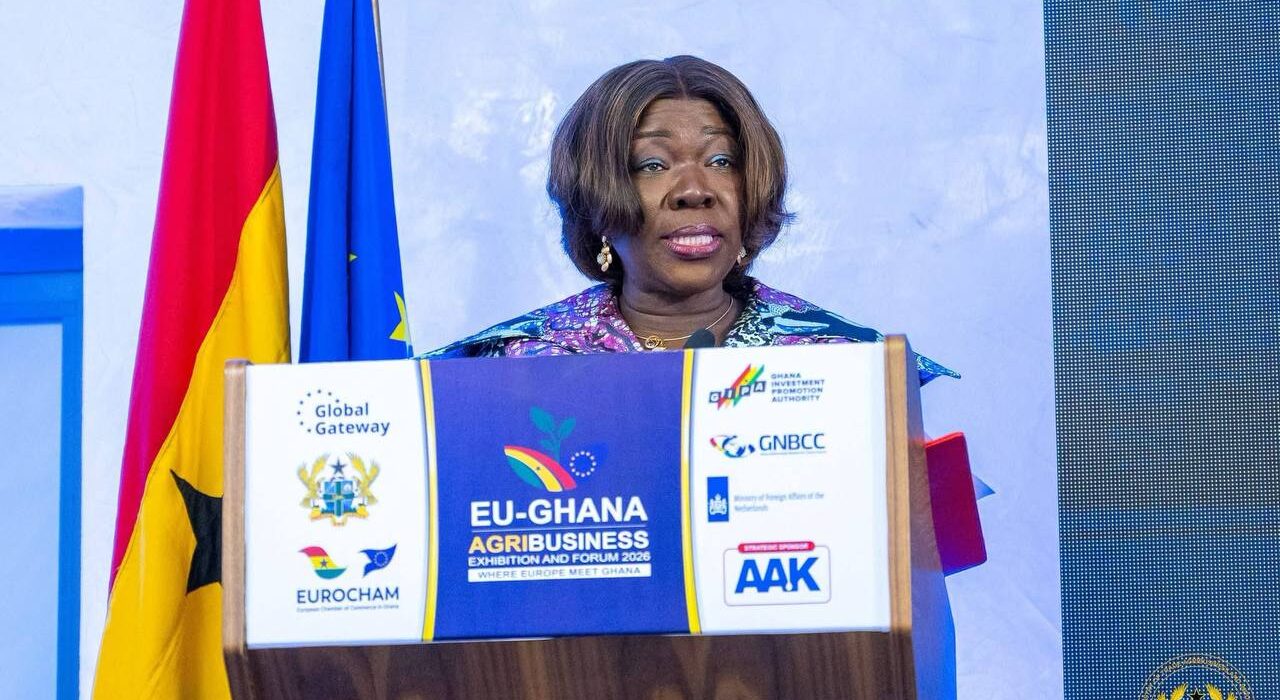
The Minister for Trade, Agribusiness and Industry, Elizabeth Ofosu-Adjare, has urged Ghanaian and European businesses seeking land for industrial and agribusiness investments to explore opportunities at the Afienya Industrial Park, as Ghana intensifies efforts to expand local processing and increase exports.
She made the appeal during the Agribusiness Exhibition and Forum organised by the European Chamber of Commerce in Ghana (EuroCham Ghana) from October 28 to 29 at Palms by Eagles Hotel, under the theme “Where Europe Meets Ghana”.
“We are also committed to revitalising existing enterprises, developing SMEs, and establishing industrial parks and special economy zones to support manufacturing and value addition. And so, to those looking for land, I’m happy to tell you that the Ministry of Trade, Agribusiness, and Industry, with our agency, the Prezios Authority, has already cut a saw for an industrial park in Opinia, Tama, and it is ready for you to take precautions.”
The forum brought together Ghanaian and European businesses, investors, policymakers and other stakeholders to explore opportunities for collaboration, showcase innovations and strengthen partnerships across the agribusiness value chain.
Land availability emerged as one of the key concerns raised by investors and agribusiness operators, prompting the minister to direct their attention to the Afienya Industrial Park as a potential location for establishing or expanding their operations.
The industrial park, being developed by the Ghana Free Zones Authority (GFZA), covers approximately 1,238 acres and is expected to accommodate more than 120 enterprises. It is intended to provide serviced industrial land, factory shells and essential infrastructure for businesses in manufacturing, agro-processing, pharmaceuticals, logistics and other sectors.
Located about 20 kilometres from the Tema Harbour and 35 kilometres from Kotoka International Airport, the park is also expected to benefit from its proximity to the Tema-Mpakadan railway line, providing transport links for raw materials and finished products.
The development follows the full occupancy of the Tema Export Processing Zone, which has created demand for additional industrial space
The minister further urged European businesses to build long-term partnerships with Ghanaian processors, entrepreneurs, research institutions and technical training organisations to strengthen local production capacity and promote technology transfer.
The forum also featured masterclasses on mandatory and voluntary European Union market requirements, equipping Ghanaian processors and agribusiness operators with information on the standards and certification processes needed to access European markets.
Ofosu-Adjare encouraged Ghanaian businesses to prioritise product quality, certification and compliance with international standards, while calling on European partners to clearly communicate their market requirements to facilitate exporters’ preparations.
The discussions come as Ghana seeks to move away from exporting predominantly raw materials towards processing more of its produce locally to retain value, expand industrial capacity, strengthen the economy and improve farmers’ livelihoods.
The European Union remains a major destination for Ghanaian exports. Eurostat data show that EU imports of goods from Ghana rose to approximately €3.74 billion in 2025, from €3.04 billion in 2024, representing an increase of 23.2 per cent. The figures cover merchandise trade across sectors and are not limited to agribusiness.
Ghana’s non-traditional export sector also recorded strong growth in 2025, earning US$5.006 billion, a 30.7 per cent increase from the US$3.83 billion recorded in 2024, according to the Ghana Export Promotion Authority (GEPA).
Processed and semi-processed products generated US$3.09 billion, accounting for 83.47 per cent of total non-traditional export earnings. Cocoa derivatives, including cocoa paste, butter and powder, remained the leading contributors to the sector’s performance.
Europe was Ghana’s largest regional destination for non-traditional exports, generating US$2.29 billion in 2025, an increase of 55.34 per cent. The Netherlands emerged as the leading destination for Ghanaian non-traditional exports, followed by Burkina Faso and the United States.
Ghana and the European Union have operated an interim Economic Partnership Agreement since 2016, providing Ghanaian goods, with the exception of arms and ammunition, duty-free and quota-free access to the EU market. The agreement offers opportunities for Ghanaian businesses to expand exports, although meeting product-specific standards and regulatory requirements remains essential.
The government’s push for industrial infrastructure and value addition is expected to support efforts to expand Ghana’s export base, create jobs and strengthen the competitiveness of locally manufactured and processed products in international markets.
Related Posts