
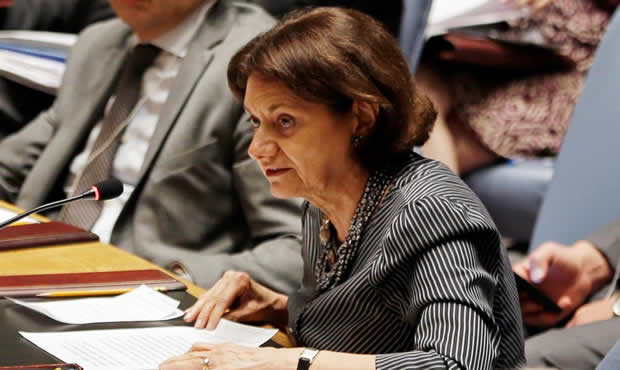
A senior U.N. official warned Wednesday that the current political standoff in Libya could lead to instability and two parallel governments in the country.
“As long as the standoff over executive legitimacy continues, Libya could again see two parallel administrations,” U.N. political chief Rosemary DiCarlo told the U.N. Security Council. “This could lead to instability and possibly unrest and deal a severe blow to the prospect of elections.”
Libya’s latest political crisis began with the postponement of December 24 presidential and parliamentary elections over disputes about election laws and who could be a presidential candidate. Nearly 3 million Libyans had registered to take part in the vote.
Following the postponement, the House of Representatives adopted a constitutional amendment calling for the appointment by February 24 of a constitutional review committee representing the country’s three regions. The committee still has not been formed.
On March 1, legislators in the House of Representatives voted to confirm a new transitional government, with Fathi Bashagha, a former interior minister, as prime minister. His Cabinet was sworn in two days later.
“The U.N. received reports that the vote was marred by procedural flaws and threats of violence against some members of the chamber and their families,” DiCarlo said. “These shortcomings impacted the credibility of the process.”
DiCarlo said the situation on the ground has remained relatively calm, but there has been an increase in threatening rhetoric and political tensions. Local flights between the capital and eastern Libya are suspended, and some forces in the country’s west have moved toward Tripoli.
“The Government of National Unity leadership has rejected the legitimacy of the vote, stating that they will only transfer power to an elected government,” DiCarlo said of the government headed by incumbent Prime Minister Abdul Hamid Dbeibah. “Mr. Bashagha, meanwhile, insists he is heading the legitimate government.”
U.N. special adviser Stephanie Williams has been talking to stakeholders and trying to find a consensus on the legal and constitutional framework to hold elections as soon as possible. She has also offered to mediate between the rival prime ministers.
Risks of polarization
“The United Nations continues to urge both parties to engage in a constructive dialogue to resolve the political impasse and to refrain from unilateral actions that could result in further divisions,” DiCarlo said.
She said this new phase of political polarization risks dividing national institutions and reversing gains made over the past two years.
“We know from experience what unilateral actions, divided government and an unending transition may hold in store for Libya,” she cautioned. “We remain convinced that credible, transparent and inclusive elections based on a sound constitutional and legal framework are the only solution to the current stalemate.”
Libya’s U.N. envoy agreed the country is at a complex and precarious moment.
“Here we are today going through a very critical phase,” Ambassador Taher El-Sonni said. “We are on a dangerous crossroads with the specter of political and institutional division haunting us again.”
El-Sonni said the focus must be on de-escalation and holding elections as soon as possible. He urged the U.N. to send election support.
El-Sonni said all Libyan stakeholders have pledged not to resort to violence to resolve the current political crisis.
“It is high time to end the cycle of conflict that lasted since 2011,” he said. “It is high time to overcome the painful differences of the past and start together a genuine national compact that will unite us, not divide us, that would make us stronger, not weaker.”
Instability, fighting and foreign interference have proliferated in Libya since the ouster and killing of longtime dictator Moammar Gadhafi in 2011.
Source: voanews.com
Related Posts