
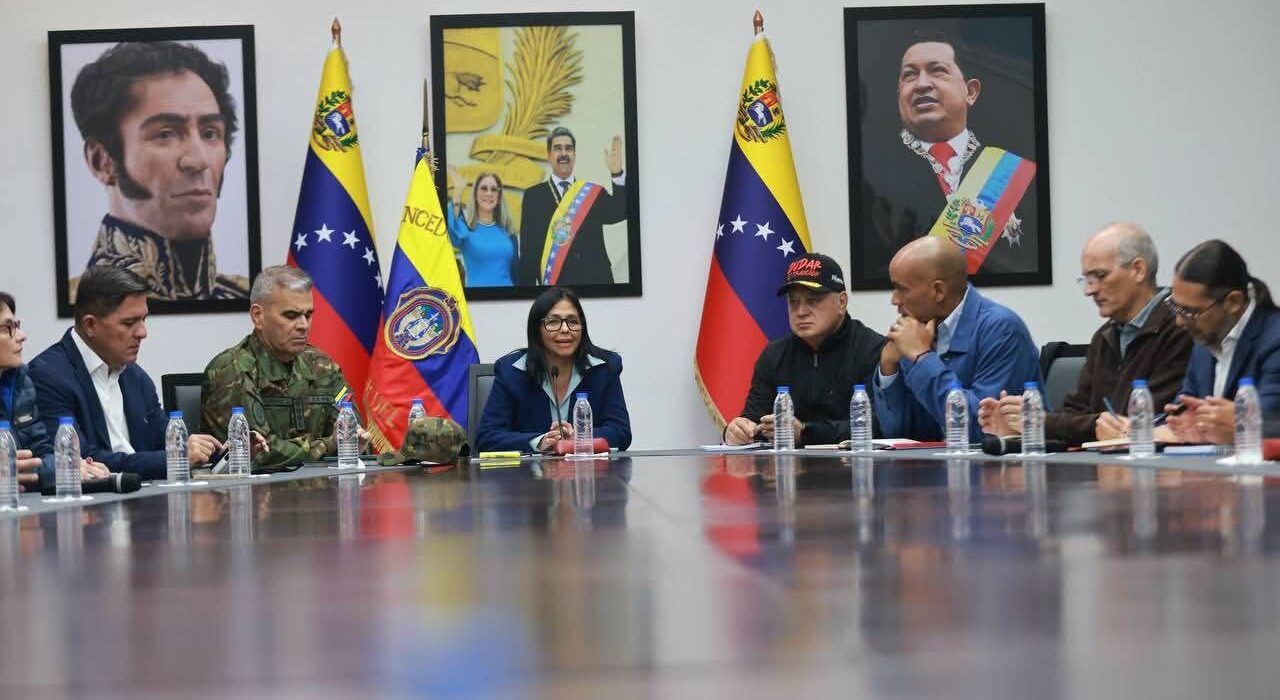
Venezuela’s Vice President Delcy Rodríguez, who assumed leadership after the U.S. military capture of President Nicolás Maduro, has publicly shifted her position on U.S. engagement in Venezuelan governance, moving from outright rejection to a call for cooperation.
The dramatic turn comes in the wake of a large-scale U.S. military operation in Caracas that resulted in the arrest of Maduro and his wife, Cilia Flores, by U.S. forces and their subsequent transfer to the United States to face criminal charges relating to narco-terrorism and possession of weapons. President Donald Trump has stated that the U.S. will “run the country,” at least during a transitional phase, asserting Washington’s role in stabilising the crisis following Maduro’s capture.
In her new statement, Rodríguez struck a markedly conciliatory tone, reaffirming Venezuela’s desire for peace and respectful international cooperation, calling on the U.S. for an agenda of cooperation, while simultaneously asserting Venezuela’s sovereignty and legal boundaries.
“Venezuela reaffirms its commitment to peace and peaceful coexistence. Our country aspires to live without external threats, in an environment of respect and international cooperation… We invite the U.S. government to collaborate with us on an agenda of cooperation oriented towards shared development within the framework of international law.” she wrote
She underscored that fundamental international principles of sovereignty and non-interference should guide any balanced relationship between Venezuela, the U.S., and other nations in the Caribbean region. Rodríguez’s invitation to the U.S. for cooperation was therefore narrowed and conditional, framed within international law to preserve Venezuela’s diplomatic integrity while prioritising domestic development.
“We invite the U.S. government to collaborate with us on an agenda of cooperation oriented towards shared development within the framework of international law to strengthen lasting community coexistence,” she said.
Rodríguez anchored her appeal to a broader vision of peace, saying that President Trump, Venezuelans, and the entire region “deserve peace and dialogue, not war,” echoing what she described as Maduro’s longstanding message.
This position represents a notable reversal from her reaction immediately after the U.S. strikes. In remarks broadcast on Venezuelan television shortly after Maduro’s capture, Rodríguez denounced the operation as a “barbaric” and “illegal” attack on Venezuela’s sovereignty and described the capture as an act that must be resisted.
Her initial stance reflected the broader Venezuelan government response, which framed the U.S. operation, dubbed “Absolute Resolve” by Washington, as a violation of international law and an illegitimate intervention. Critics within Caracas and allied states called for resistance to what they described as a regime-change strategy.
In contrast, her latest public message invites collaboration and positions Venezuela as seeking a path toward diplomatic engagement, despite the intense geopolitical backdrop. This shift comes as President Trump has openly discussed a continued U.S. role in Venezuelan governance, including possible further military actions if Caracas does not cooperate.
President Nicolás Maduro is expected to be arraigned before a New York court today, facing charges of narco-terrorism
Related Posts