
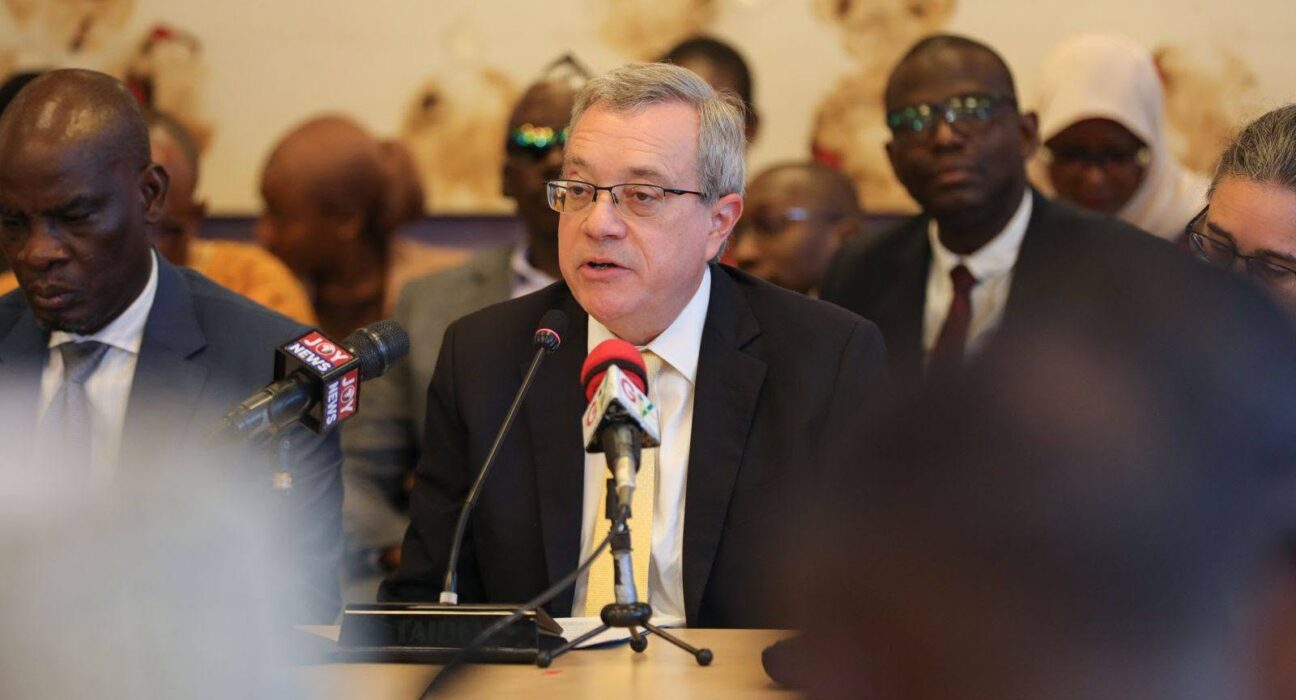
The World Bank Country Director for Ghana, Robert Taliercio O’Brien, has called for stronger investment in skills development within Ghana’s education system to address the growing mismatch between the skills demanded by the private sector and those acquired by students.
Mr Taliercio O’Brien attributed the skills gap to contributing to the difficulties young people face in transitioning into the workforce, even as unemployment remains a persistent challenge, underscoring the need to make skills development a central priority in Ghana’s education and employment agenda.
He made the call at the Ghana and Regional Foundational Learning Evidence and Implementation Support Day, where stakeholders in the education sector reviewed evidence, shared regional lessons and identified priority actions to strengthen foundational learning. The gathering also featured discussions on the establishment of the Ghana Education Evidence Data Laboratory (GEEDLAB).
The event brought together the Minister for Education, Haruna Iddrisu, UNICEF, the Jacobs Foundation and other education-sector partners to examine ways of strengthening literacy, numeracy and digital skills from the foundational stages of education.
Mr Taliercio O’Brien emphasided that the World Bank’s renewed focus in Ghana was on creating “more and better jobs”, with stronger foundational learning serving as a critical starting point for equipping young people with the skills required to succeed in school and later in the workplace.
“On behalf of the World Bank Group, I can say we’re committed to helping Ghana create more and better jobs. That’s our new central focus. And that starts with foundational skills children need to succeed in school and at work. We’re also renewing how we build and share knowledge so that what works can be replicated and scaled,” he stated.
He noted that Ghana had made significant progress in expanding access to education, with gross enrolment at the kindergarten and primary levels rising substantially since 2000 as a child born in Ghana today could expect to complete 10.7 years of schooling, describing the expansion in access as notable progress.
However, Mr Taliercio O’Brien cautioned that access to education alone was not enough, as many children continue to complete the early grades without mastering the skills expected for their age. He said these learning gaps accumulate over time and leave many students inadequately prepared for secondary education and the demands of the workforce.
Citing the skills challenge, he noted that 49% of candidates obtained A1–C6 in Core Mathematics in the 2025 WASSCE, while 2019 data showed significant gender disparities in ICT skills among young people, with 22% of males and 8% of females reporting ICT-related skills or activity in the relevant measure.
“In 2025, just 49% of candidates passed the West African Senior School Certificate Examination in Mathematics. And in 2019, an IFC study found that just 22% of adolescent boys and 8% of adolescent girls have relevant ICT skills, while more than 60% of jobs need at least basic digital fluency. So again, you see the mismatch between what the private sector needs and what the education system is currently providing.” he stated
He stated the World Bank and its partners were supporting efforts to address the problem at its foundation through programmes aimed at improving reading and mathematics skills. He also noted that additional financing, including grant resources, was helping Ghana scale up interventions nationwide, but stressed that their success would depend on effective implementation and the systematic use of evidence.
Related Posts