
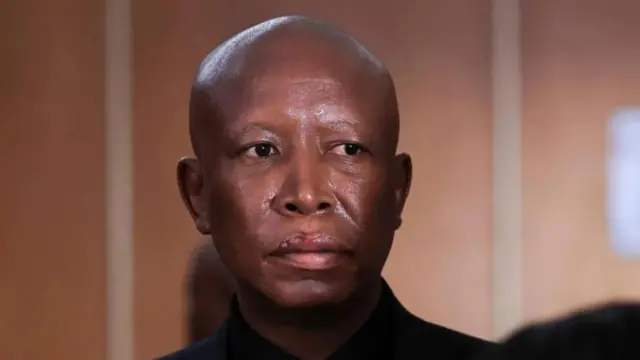
South Africa’s opposition leader and head of the Economic Freedom Fighters, Julius Malema, has been handed a five-year prison sentence after a court found him guilty of unlawfully possessing and firing a firearm during a political gathering.
The judgment was delivered by a magistrate court in East London, located in South Africa’s Eastern Cape Province.
The conviction relates to a 2018 political rally commemorating the fifth anniversary of the EFF, where Malema was captured on video firing what appeared to be a rifle into the air. The footage later circulated widely online, triggering public concern and ultimately leading to legal proceedings under South Africa’s firearm regulations.
Malema, 45, was convicted on multiple charges including unlawful possession of a firearm, unlawful possession of ammunition, discharging a firearm in a public space, and reckless endangerment. The court ruled that the act posed a danger to public safety and violated firearm regulations.
Delivering the ruling, Magistrate Twanet Olivier emphasized the seriousness of gun violence in South Africa, noting that public figures must exercise restraint and responsibility given their influence over supporters and the wider public.
Malema had pleaded not guilty, arguing the act was celebratory rather than dangerous. However, the court dismissed this claim after reviewing video evidence and witness testimony.
Prosecutors had earlier pushed for a maximum 15-year sentence, arguing that leniency would set a dangerous precedent, particularly because Malema is a political leader with a large youth following. They stressed that lawmakers must not appear to encourage unlawful behavior.
Following the sentencing, Malema’s legal team immediately applied for leave to appeal, indicating that the case could move to higher courts. If the appeal fails, Malema could serve the full prison term.
Legal analysts note that a prison sentence exceeding 12 months could also affect Malema’s political career, potentially disqualifying him from serving as a Member of Parliament, according to South African constitutional provisions.
The ruling represents a major development for the Economic Freedom Fighters, which is currently South Africa’s fourth-largest political party with strong support among young voters and working-class communities.
The charges were originally brought following complaints from lobby group AfriForum, which argued that Malema’s actions violated firearm laws and endangered public safety. Malema, however, has maintained that the case was politically motivated.
Malema remains one of South Africa’s most controversial political figures, known for advocating land expropriation without compensation, nationalization of mines, and broader economic reforms aimed at addressing inequality in post-apartheid South Africa.
The sentencing is expected to have significant political implications ahead of upcoming political developments in South Africa, with analysts suggesting that any prolonged legal battle or imprisonment could reshape opposition politics and influence the country’s political landscape
Related Posts