

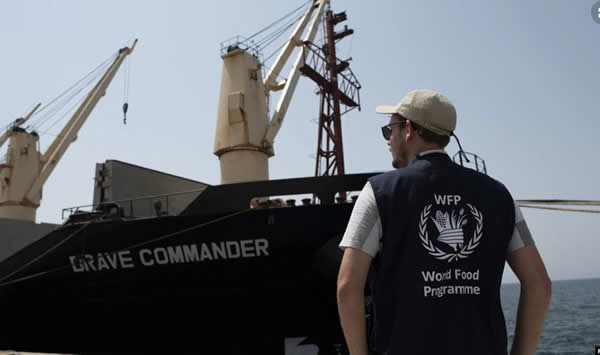
The first shipment of Ukrainian grain to Africa since Russia’s invasion arrived in Djibouti on Tuesday. The grain will be distributed in Ethiopia to help the drought-stricken nation cope with worsening hunger that threatens to become a famine.
Mike Dunford, East Africa regional director for the U.N.’s World Food Program (WFP), spoke to reporters at the port.
“The food on the [U.N.-chartered ship] Brave Commander will feed 1.5 million people, for one month in Ethiopia,” he said. “So, this makes a very big impact, for those people who currently have nothing and now WFP will be able to provide them with their basic needs.”
A Russian blockade of Ukraine’s seaports forced Ukraine to halt nearly all deliveries of grain, which sparked worries of a worldwide food crisis. Russia invaded the country in February.
A settlement between Kyiv and Moscow that was mediated by the U.N. and Turkey in July, known as The Black Sea Initiative, saw a resumption in exports of wheat, other foodstuffs, and fertilizers from three Black Sea ports at the beginning of August.
The WFP said 150,000 tons of additional wheat grain from Ukraine will be sent in the coming weeks thanks to funding provided by the United States.
In landlocked Ethiopia, where the grain is now headed, more than 5 million people have been displaced because of conflict. A total of 17 million people are in need of humanitarian assistance as the Horn of Africa endures another year of drought.
Dunford said the Black Sea Initiative is a step toward easing the situation.
“We’ve already seen a reduction of 15% in wheat prices globally, since the Black Sea Initiative commenced,” he said. “What we want to see is more food flowing. We need, from WFP’s perspective, millions of tons in this region. In Ethiopia alone, three quarters of everything that we used to distribute originated from Ukraine and Russia.”
There are concerns the resumption of exports from Ukraine may not be enough to make a dent in the crisis.
Adullahi Halakhe, with the Washington-based advocacy group Refugees International, said the amount of grain arriving to Ethiopia is not enough.
“When you consider over 20 million people are in need of humanitarian aid, food inflation stands at 40%, I think this is very important,” he said.
Humanitarian organizations say parts of Ethiopia’s northern Tigray region may be in a state of famine, because of the conflict there and a de facto humanitarian blockade imposed by Ethiopia’s federal government.
Although limited aid was entering the region, renewed fighting between the government and Tigrayan forces that began last week led to the U.N. announcing Monday that it has suspended aid convoys into the region.
Source: voanews.com
Related Posts