
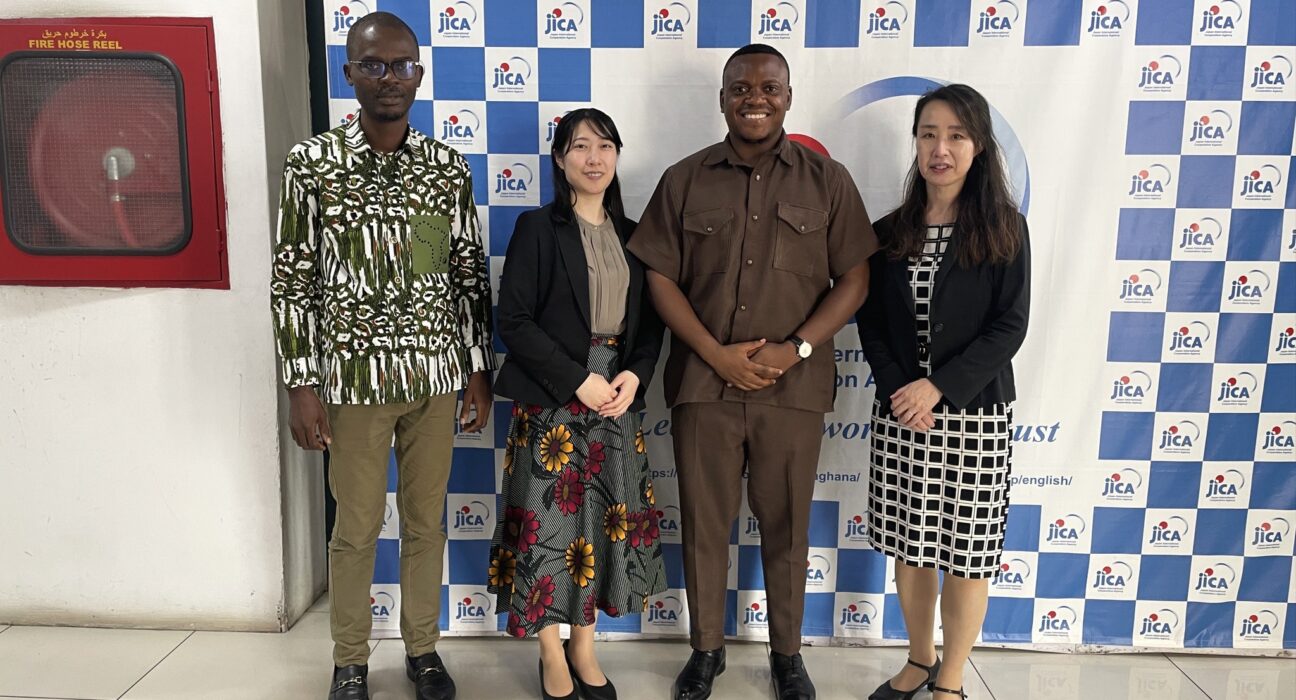
A delegation from the Headquarters Mission of the Japan International Cooperation Agency (JICA) has concluded a working visit to key institutions in Ghana as part of efforts to advance collaborative opportunities in the space sector, with a particular focus on leveraging Earth observation data for development across Africa.
The visit underscores Japan’s growing commitment to strengthening space science cooperation on the continent, emphasising human resource development, institutional capacity building and the creation of scalable frameworks for practical applications of satellite data.
These areas are seen as critical components in building a stronger and more resilient African space ecosystem, one that supports sustainable development, climate resilience, natural resource management and disaster risk reduction.
During their time in Ghana, the JICA team held strategic engagements with a range of government and academic institutions, including the Ghana Space Science and Technology Institute (GSSTI), the Ministry of Environment, Science, Technology and Innovation (MESTI), the Ministry of Finance, the University of Ghana, and All Nations University. These visits provided opportunities for in‑depth dialogue on ongoing initiatives, existing needs and potential areas of technical and policy cooperation.
Discussions centred on efforts to develop Earth observation capacities, and how Japan’s expertise and technology could support the processing, analysis and utilisation of satellite data for national and regional development objectives. Stakeholders examined pathways for integrating Earth observation data into agriculture, water management, urban planning and natural resource monitoring.
Academic partnerships received significant attention during the visit. At the University of Ghana and All Nations University, the delegation’s engagements were aimed at building a pipeline of skilled professionals with expertise in satellite data science, remote sensing, geographic information systems (GIS) and related technologies.
A central theme of the discussions was the importance of regional collaboration. The mission team and Ghanaian counterparts explored how West and East African institutions, including those in Kenya, Senegal and Rwanda, can align strategies for leveraging Earth observation data and build interconnected networks that support data sharing, joint research and coordinated responses to climate and development challenges.
Further talks also focused on strengthening institutional and human resource capacities to support the formulation and implementation of national space policies. This includes enhancing abilities to process, analyse and visualise Earth observation data, and creating more robust collaborative frameworks with Japan and other regional partners.
By fostering these partnerships, the missions aim to establish a scalable structure for practical, operational applications of satellite data that extend beyond research into economic and development impact. This could include early warning systems for natural disasters, precision agriculture support for smallholder farmers, coastal and marine monitoring, and improved land‑use planning.
Japan’s engagement in Ghana forms part of a broader ambition to support Africa’s space ambitions, combining technological transfer with skills development and institutional strengthening. As African states continue to invest in space infrastructure and expertise, initiatives like this working visit by JICA are expected to accelerate capacity building, deepen regional cooperation and contribute to evidence‑based decision making for sustainable development across the continent.
Related Posts