
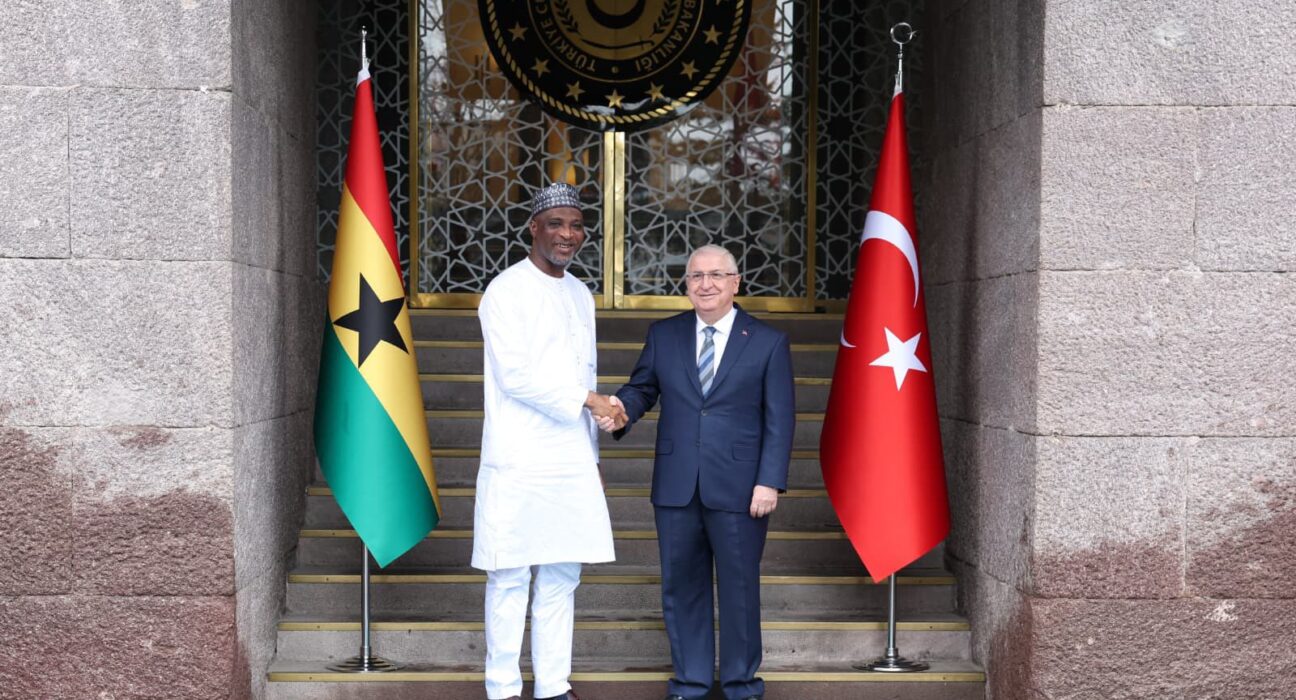
Ghana’s Minister for the Interior, Muntaka Mohammed-Mubarak, has held high-level discussions with his Turkish counterpart, Mustafa Çiftçi, in a move that signals deepening security and defence cooperation between Accra and Ankara.
The engagement focused on strengthening collaboration in emergency response, migration governance and transnational security threats, reflecting a shared recognition of evolving global risks.
According to the Minister, discussions covered disaster management, organised crime, terrorism, drug trafficking and irregular migration, areas that increasingly require cross-border intelligence sharing and coordinated enforcement.
The Ghanaian delegation included the Controller-General of the Ghana Immigration Service, Samuel Basintale Amadu; the Director-General of the Motor Traffic and Transport Department (MTTD), COP Gabriel Prince Waabu; officials from the Ministry of the Interior; and representatives of the National Disaster Management Organisation (NADMO). Their presence underscored the multi-agency nature of the cooperation framework being pursued.
The talks come at a time when both countries are recalibrating their security partnerships amid shifting migration routes, rising organised crime networks and the need for more robust disaster preparedness systems.
Türkiye’s strategic geographic position, bridging Europe and Asia, gives it a pivotal role in migration and counterterrorism coordination, while Ghana continues to position itself as a stable security anchor in West Africa. The engagement therefore reflects not only bilateral interest but a broader strategic alignment within Africa-Asia security cooperation.
Defence diplomacy has also gathered momentum. In a recent engagement, the Turkish Defence Attaché to Ghana, Colonel Ahmet Pakis, paid a courtesy call on the Chief of the Air Staff, Air Vice Marshal Eric Agyen-Frempong, at the Air Force Headquarters in Accra on May 19, 2025. The meeting further reinforced military-to-military ties and highlighted expanding defence dialogue between the two countries. Such engagements are often precursors to enhanced training exchanges, technical cooperation and defence industry collaboration.
Economic relations continue to provide a strong foundation for the growing partnership. Trade between Ghana and Türkiye reached nearly $888 million in 2023, with Ghana exporting more than $614 million worth of gold and Türkiye exporting approximately $274 million in goods, including cement, pasta, flour, iron and steel products, insulated cables and chemical fertilizers. Both governments have expressed ambition to grow bilateral trade to $1 billion by 2027, a target that would further institutionalise economic interdependence alongside security cooperation.
Diplomatic relations between the two countries date back to 1958, shortly after Ghana’s independence. The Turkish Embassy in Accra first opened in 1964, closed in 1981 due to austerity measures, and reopened on February 1, 2010.
Ghana established its embassy in Ankara in 2012. High-level visits have consistently elevated the relationship, including former Turkish President Abdullah Gül’s visit to Ghana in 2011 and former Ghanaian President John Dramani Mahama’s visit to Türkiye in 2013. President Recep Tayyip Erdoğan’s visit to Ghana in 2016 marked a significant milestone, accompanied by a major business forum involving 150 Turkish and Ghanaian business leaders.
Beyond security and trade, cooperation extends into development and education. Türkiye provides development assistance to Ghana through its cooperation agency and has offered scholarships to Ghanaian students since 1992, strengthening people-to-people ties. Aviation connectivity further supports bilateral engagement, with Turkish Airlines operating seven weekly flights to Accra, enhancing travel, trade logistics and diplomatic exchanges.
Taken together, the latest high-level security discussions and defence engagements reflect a relationship that is evolving beyond traditional diplomacy into a multidimensional strategic partnership, anchored in security collaboration, expanding trade and deepening institutional cooperation.
Related Posts