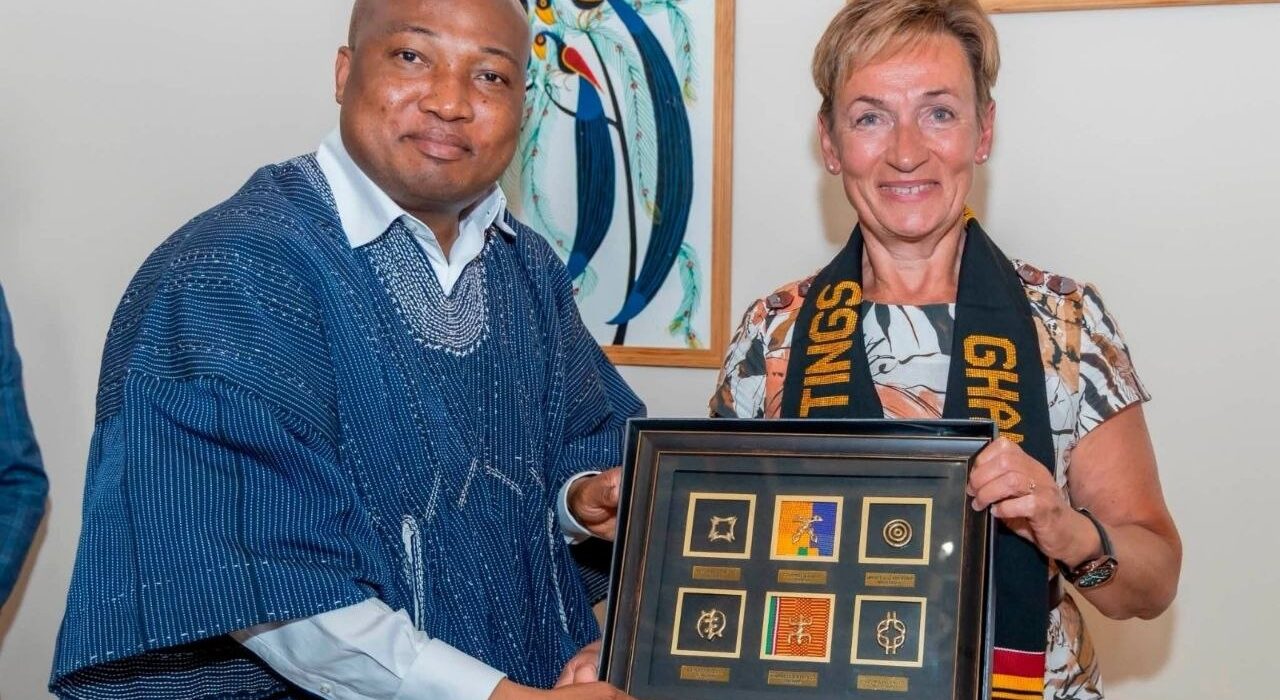
The Minister of Foreign Affairs, Samuel Okudzeto Ablakwa, has announced that Ghana and the Russian Academy of Sciences will deepen cooperation on industrialisation and value addition, as the country seeks to move away from the export of raw materials and strengthen domestic processing.
Mr Ablakwa made the announcement following an engagement with Professor Irina Olegovna Abramova, Director of the Institute for African Studies of the Russian Academy of Sciences, in Moscow, as part of his high-level visit to Russia, which also included talks with Russian Foreign Minister Sergey Lavrov.
According to the Minister, the engagement resulted in an agreement for the Russian academic institution to work with Ghana on President John Dramani Mahama’s industrialisation agenda, particularly the country’s ambition to end the export of raw materials without significant domestic processing and instead promote value addition to its natural resources.
“It is worth highlighting that Ghana and the Russian Academy of Sciences have agreed to work together on President Mahama’s vision of industrialization and value addition as Ghana seeks to stop the export of raw materials by 2030; we shall also be working together on reparatory justice research; and sponsoring PhD scholarships for Ghanaian and Russian scholars,” he stated.
The proposed collaboration comes as the Mahama administration places industrialisation and value addition at the centre of its economic transformation agenda, with the government seeking to strengthen domestic production, expand manufacturing and retain a greater share of the value generated from Ghana’s natural resources within the country.
The industrialisation agenda has been at the centre of the Foreign Minister’s visit, featuring prominently during his engagement with Sergei Lavrov, where Ablakwa described the current extractive agreement model, under which resources are mainly exported from the country, as “rigged”, and called for greater African sovereignty over its resources.
He noted that this forms part of the reparatory justice agenda being championed by Ghana, which seeks to reform the existing extractive architecture and move away from the colonial model, allowing Africans to exercise greater control over the pricing and value of their natural resources.
He also emphasized that such reforms are essential to advancing Africa’s economic emancipation and are strongly supported by President Mahama.
Ablakwa further stated that Russia had pledged its support for the new economic paradigm Ghana is pursuing, aimed at ending the exploitation of the country’s resources and ensuring greater value is retained within Ghana.
“It’s also about sovereignty. It’s about allowing African countries to take control of our resources. We don’t want to be exporting raw materials any longer, and President Mahama has been clear about that, and I raised that at a meeting. I want to commend Russia for declaring their support for a new economic paradigm where we will no longer be at the mercy of exploitation,” Mr Ablakwa stated.
The cooperation with the Institute for African Studies is also expected to extend beyond industrialisation. According to the Minister, Ghana and the Russian institution will collaborate on reparatory justice research and create opportunities for PhD scholarships for Ghanaian and Russian scholars, potentially strengthening academic exchanges and joint research between the two countries.
The reparatory justice component builds on Ghana’s wider diplomatic campaign for international recognition and action on the historical consequences of the transatlantic trafficking and enslavement of Africans. Russia was among the countries that voted in favour of the United Nations General Assembly resolution on reparatory justice adopted in 2026, while Russian representatives also participated in Ghana’s Next Steps Conference on Reparatory Justice in Accra.
The Minister’s engagement with the Russian institute therefore brings together two areas that Ghana has increasingly linked in its international diplomacy: economic sovereignty and historical justice. For Ghana, research into reparatory justice is not limited to compensation for historical wrongs but also involves examining contemporary economic structures and relationships that affect Africa’s ability to determine the value and use of its resources.
The Institute for African Studies, established in 1959, is a major Russian research institution dedicated to the study of Africa, covering areas including African political systems, economies, international relations, history, societies and cultures. Its work provides an academic platform through which Russian scholars study developments across the continent and engage with African researchers and institutions.
Its relationship with Ghana also reflects the broader intellectual and educational links that developed between Ghana and the Soviet Union following independence. Under Osagyefo Dr Kwame Nkrumah, Ghana established extensive political, economic, educational and technical relations with the Soviet Union as the country pursued an independent development path and sought to build the human capital required for post-independence transformation.
Hundreds of Ghanaians received educational and technical training in the Soviet Union during the Nkrumah era, while Soviet institutions developed a sustained scholarly interest in Nkrumah’s political thought, African unity and the challenges of colonialism and neocolonialism. That historical relationship has continued through academic research and contemporary exchanges between Ghanaian and Russian institutions.
The connection has extended to Ghana’s political literature. The Institute has engaged with the works and legacy of Nkrumah, while President Mahama’s memoir, My First Coup d’État and Other Stories from the Lost Decades of Africa, was translated into Russian and presented at the Institute for African Studies in Moscow. The development provides a contemporary link between Ghana’s political history and Russia’s longstanding scholarly interest in Africa.
Mr Ablakwa expressed appreciation to Professor Abramova and her colleagues for their engagement and acknowledged the Institute’s longstanding interest in Africa.
“It is a matter of extreme pride to note that Ghana is the only African country to have the Russian Academy of Sciences translate the literary works of two of our Presidents, Osagyefo Dr. Kwame Nkrumah and His Excellency John Dramani Mahama into the Russian language which are also bestsellers,” he stated.
The new cooperation could therefore provide Ghana with an additional academic and research partner as the government pursues its industrialisation agenda, particularly in developing ideas and expertise around value addition, resource governance and economic transformation.
For Ghana and Russia, the engagement also builds on decades of political, educational and intellectual relations that began during the early years of Ghana’s independence and have evolved into contemporary cooperation spanning diplomacy, trade, education, research and development.
Related Posts