
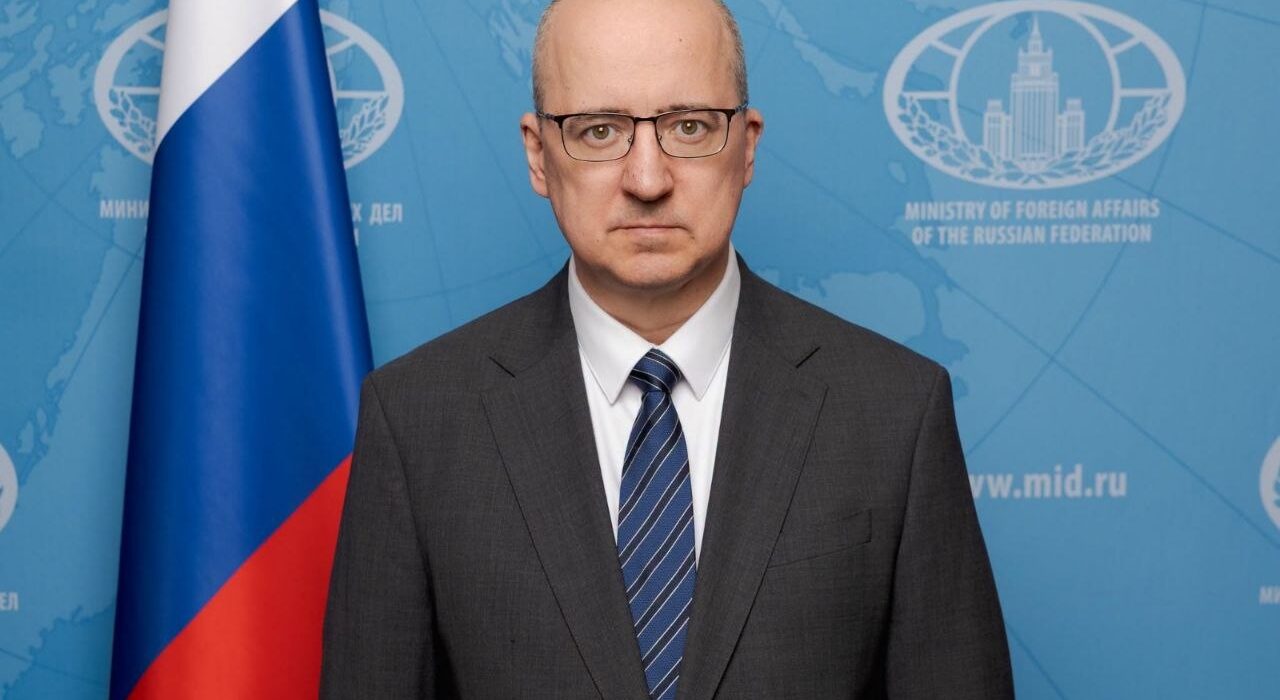
In written responses to questions from Diplomatic Times, Russian Ambassador to Ghana Andrei Ordash outlines Moscow’s priorities in Ghana, its broader Africa strategy and Russia’s position on the war in Ukraine.
Disclaimer: The views expressed in this written responses are those of the Russian Ambassador and do not necessarily reflect the views of the Diplomatic Times.
1. As you begin your tenure in Ghana, what are your key priorities, and which areas of Ghana-Russia cooperation are you looking to strengthen?
First and foremost, I would like to thank “Diplomatic Times” for its interest in Russian-Ghanaian relations. It is a great honour for me to assume the duties of Ambassador Extraordinary and Plenipotentiary of the Russian Federation to the Republic of Ghana.
My priorities in this post are fully in line with Russia’s overall policy of developing multifaceted cooperation with African countries, as set out in the decisions of the Russia-Africa summits in Sochi (2019) and St Petersburg (2023). Africa is a rapidly developing continent, and Ghana, as one of the key players in West Africa, is a reliable and promising partner for us.
Our main task is not simply to maintain, but to significantly build on the positive momentum that has already emerged in our bilateral relations. In recent years, trade between our countries has more than tripled and, by the end of 2024, exceeded 800 million dollars. Russia occupies a significant position among Ghana’s suppliers of petroleum products, fertilisers and grain. However, we are convinced that this is by no means the limit.
I see several key areas on which we will be focusing in the near future:
Firstly, this involves strengthening trade and economic cooperation. Russia and Ghana have vast prospects for joint business ventures – projects of all scales are in demand, ranging from large-scale investment projects to small and medium-sized enterprises. We see considerable interest from Ghana in imports of Russian agricultural produce, as well as in attracting Russian investment into the mining sector.
Secondly, we are ready to share with Ghana our extensive expertise in the fields of energy and new technologies. Of particular interest is the resumption of dialogue on the development of nuclear energy in Ghana. It is important that Russia advocates for energy justice – equal access for all countries to the necessary resources and technologies.
Thirdly, there is the humanitarian sphere and education. We have strong, historic ties in this area. A large number of Ghanaians were educated in the Soviet Union and Russia. Today, interest in the Russian language and Russian higher education in Ghana continues to grow. We intend to actively foster this trend, including through annual state scholarships for Ghanaian students. We also see great potential in developing cultural exchanges and strengthening direct people-to-people contacts.
Finally, I would like to note that our relations are built on a solid political foundation. The President of Ghana, John Dramani Mahama, who was educated in our country, has repeatedly reaffirmed his commitment to deepening friendly ties with Russia. This presents a unique opportunity to take our cooperation to a whole new level.
2. What are the priorities of the Ghana-Russia relations going into the third Russia-Africa Summit?
The forthcoming third Russia-Africa Summit, to be held in Moscow on 28-29 October 2026, is not merely a diplomatic event, but a strategic milestone that will open a new chapter in our relations. It is of utmost importance to us that a Ghanaian delegation at the highest level takes part in the summit. This is clear evidence of a mutual desire to deepen our dialogue.
The main objective is to give our relations with Ghana tangible economic substance. The summit’s agenda will focus on trade, investment, energy, logistics and high technology. Following the meeting, we plan to draw up a package of measures specifically in these areas. We expect the delegations from African states to include relevant ministers and representatives of the business community, who will take part in the economic and humanitarian forum on the sidelines of the summit.
An important milestone will be the adoption of a new roadmap – the Russia-Africa Cooperation Plan for 2026–2029. This document will set out the key areas of joint work for the next three years. We do not want to limit ourselves to declarations – we need a practical tool that will allow us to put our agreements into practice.
The summit’s agenda extends far beyond the usual areas of focus. In addition to strengthening energy security (including nuclear energy) and food sovereignty, we plan to engage in active discussions on digital technologies and artificial intelligence, as well as the creation of independent payment systems that will allow us to conduct transactions without relying on Western financial mechanisms.
Finally, the summit will provide a platform for joint work on reforming the global governance system. Russia supports the position of African states on the need to ensure fair representation of the continent within UN structures and to create a more equitable international financial architecture.
Regarding Ghana specifically, our bilateral priorities in the run-up to the summit have already been clearly set out. During recent political consultations in March 2026, the parties discussed cooperation in agriculture, infrastructure, education, energy and technology transfer. The Ghanaian side confirmed its interest in deepening cooperation within multilateral forums.
The summit therefore presents a unique opportunity not only to formalise the current state of Russian-Ghanaian relations, but also to provide a powerful impetus for their qualitative development. We are determined to ensure that the Moscow meeting yields not merely memoranda of understanding, but concrete projects that serve the interests of our peoples.
3. Your predecessor, H.E Berdnikov, assured the Embassy’s cooperation in apprehending a young man who was allegedly linked to Russia and who non-consensually recorded sexual encounters with Ghanaian women and shared the videos online. Is this issue still on the table?
Thank you for this question. It concerns a high-profile incident which has undoubtedly been a source of preoccupation in both Ghana and Russia. I can assure you that this matter remains a priority for the Russian law enforcement agencies.
Russia’s position on the substance of the matter remains unchanged and unequivocal. We condemn any actions that violate people’s rights and dignity, including intrusions into their private lives. From the very outset, the Russian side has expressed its willingness to cooperate with the Ghanaian authorities within the existing legal and treaty framework.
I am convinced that all issues relating to this incident must be resolved through cooperation between the law enforcement agencies of the two countries.
Incidentally, this case has shown that our countries need to draw up a document regulating their relations in the field of extradition.
4. Europe has consistently contributed to security efforts in the sub-region to protect our borders from the spillover of terrorism. What is Russia’s contribution to securing Ghana’s borders against the threat of terrorism?
Before discussing Russia’s contribution, allow me to clarify the assessment of the situation you have outlined. The assertion that Europe ‘consistently contributes to security efforts’ in Africa does not always reflect the reality on the ground. We often observe quite the opposite.
The policies of a number of European countries, particularly France, have for many years led to the escalation of conflicts and destabilisation of entire regions, first and foremost the Sahel. Instead of genuine assistance to sovereign states, we see covert interference in internal affairs, support for separatists and, most cynically, direct collusion with terrorist groups.
Our concerns are shared by our partners across the continent. Following recent consultations between the Foreign Ministers of Russia and the Alliance of Sahel States (Niamey, 8 July), it was established that external state actors were involved in coordinated barbaric aggression, as well as a criminal conspiracy between Ukraine, France, certain other countries and terrorist groups operating in the Sahel. These destructive actions are aimed at undermining statehood and stability in the region.
It is particularly worrying that the Kiev regime, supported by the European Union, has become actively involved in this destructive game. Ukrainian mercenaries have recently been deployed in terrorist raids across Africa. On the African continent, France relies not only on local separatists, but increasingly on fighters from Ukrainian units, who have, in effect, opened a ‘second front’ against Russia in Africa.
Kiev’s main objective is to establish itself as a political force in Africa and to create difficulties for states that maintain partnership with Russia. Weapons supplied by European allies to the Kiev regime subsequently turn up in Africa, Asia and Latin America. Thus, so-called ‘European aid’ effectively amounts to the financing and arming of terrorism on the African continent.
In contrast to this destructive approach, Russia offers Africa, and Ghana in particular, a constructive and long-term security partnership based on the principles of sovereignty and mutual respect.
Russia is actively cooperating with a number of African states, sending military instructors and specialists to assist in the training of national armed forces and law enforcement agencies. Our contribution to the fight against terrorism on the continent has been highly praised by our partners.
Russia stands ready to assist African countries in strengthening their defence capabilities to counter internal and external threats. We provide expertise in demining and cybersecurity for critical infrastructure, and we implement training programmes for military and security personnel across the continent.
Unlike ‘short-sighted’ and dangerous proposals, Russia advocates reliable, time-tested cooperation. We are convinced that the genuine security of Ghana and the entire sub-region can only be ensured by the African states themselves, with the support of reliable and predictable partners such as Russia. We do not impose our services, but we are always ready to lend a helping hand in accordance with the requests of our Ghanaian friends.
5. Russia’s activities on the continent have been criticised as being ‘counterproductive’, especially in the area of security. Trade volumes also remain low compared to those of other foreign partners. How is Russia positioning its interests on the continent to become a reliable partner, as other countries and blocs have been?
Allow me to examine each of the points raised in a systematic and reasoned way, as they are based on outdated stereotypes and do not reflect the reality of the situation.
The claim that Russia’s actions in the security sphere are ‘counterproductive’ is not merely untrue – it is diametrically opposed to the facts. Russia’s activities in Africa have always been, and remain, constructive, responsible and aimed at strengthening the sovereignty of African states.
Unlike the approaches of some Western countries, which for decades have viewed Africa solely as a source of resources and an arena for geopolitical games, Russia has consistently advocated the principle of ‘African solutions to African problems’. It is precisely this principle, in particular, that underpins our cooperation with the countries of the Sahel.
Russia’s recently developing ties with the Confederation of Sahel States are not ‘counterproductive’, but rather a sign of respect for the choices made by the African peoples and support for their aspirations to ensure their own security. The second meeting of foreign ministers from Russia and the Sahel states, as I have already mentioned, took place in July 2026 in Niamey, where the main topics were the fight against terrorism and the security situation in the region.
We have also taken the initiative to establish working relations between the African Union and the Collective Security Treaty Organisation (CSTO) in order to coordinate approaches to responding to crisis situations and to expand the exchange of experience in peacekeeping and military-political affairs. This is yet another example of systematic, long-term work, rather than ‘counterproductive’ actions.
As for trade volumes, the picture here is quite different from the one our critics are trying to paint. Trade between Russia and Africa is showing steady and significant growth. By the end of 2025, it had exceeded 27 billion dollars. Over the course of the year, trade volumes increased by 13 per cent. Yes, in absolute terms we have room for growth, and we acknowledge that. But the trend is clear: trade between Russia and Africa is growing rapidly, despite the pressure of sanctions and the West’s attempts to isolate Russia.
Now to the most important point – reliability. Let me ask a counter-question: can we really regard as reliable partners those countries and blocs which, for centuries, have been extracting Africa’s natural resources without building up processing capacity on the continent? Those who view Africa as a ‘giant piggy bank’ rather than as an equal partner? Are those Western countries ‘reliable’ which, in practice, pursue a neo-colonial approach, focusing solely on mines and rare-earth metals, ignoring the continent’s growing economic and political potential outside the raw materials sector, imposing unequal agreements on African states and interfering in their internal affairs?
Russia offers a fundamentally different model of partnership. We do not simply supply goods – we are prepared to localise production, establish joint processing facilities on African soil and transfer technology. We support African countries’ aspirations for economic self-reliance. We are actively switching to settlements in national currencies – the share of the rouble in mutual trade with Africa exceeded 80 per cent in 2025, which protects our partners from the volatility of the dollar and the risks associated with sanctions.
Russia is working in close coordination with its BRICS partners, which include African countries such as South Africa, Egypt and Ethiopia, and, from 2025, Nigeria and Uganda as partner countries. We do not see ourselves as competing with Africa’s other partners – we complement their efforts, working for the common development of the continent within the framework of a multipolar world order.
6. We have seen Russia intensify its global outreach. In Ghana, there have been cultural and educational programmes aimed at deepening ties. Does Russia recognise that it is playing catch-up in a region dominated by the United States and China? Are there any plans to bolster its presence on the continent?
Let me state our position straight away and in the clearest possible terms: Russia is not ‘catching up’ in Africa, because we never left.
The very framing of the question of ‘dominance’ in Africa stems from a logic that is alien to us. We do not view Africa as an arena for rivalry or the ‘division of spheres of influence’. For us, African states are equal partners, not objects of geopolitical struggle.
Our relations with Africa have deep historical roots. For decades, Russia has consistently supported the African peoples in their struggle for freedom and independence, and has contributed to the establishment of African states and their socio-economic development. Relations with the African continent are currently experiencing something of a renaissance – but this renaissance is based on long-standing traditions of friendship, not on an attempt to ‘catch up’ with anyone.
Diplomatic relations between the USSR and Ghana were established on 14 January 1958 – shortly after Ghana gained independence. Ties between our countries were built on a solid foundation of solidarity and mutual assistance, which had developed over many years as Ghana established its sovereignty.
Yes, we are indeed stepping up our cultural and educational programmes in Ghana – and this is a direct reflection of our growing mutual interest. There are currently over 600 Ghanaian citizens studying in our country. For the 2025/2026 academic year alone, 120 scholarships have been allocated to our Ghanaian partners under the quota for study at Russian higher education institutions, funded by the federal budget. At the University of Ghana and the University of Media, Arts and Communications, over 500 students are studying Russian with lecturers from Russia, and this figure is set to rise.
These programmes are not a ‘catch-up’ strategy, but rather a natural development of our long-standing partnership, responding to the needs of Ghanaian society.
Russia has clear plans to strengthen its presence on the continent, and these are already being implemented. We are expanding our diplomatic presence in Africa and working on the creation of new intergovernmental mechanisms. Russia is stepping up its cooperation with regional organisations, including the African Continental Free Trade Area, whose secretariat is based in Accra.
Russia is strengthening its presence in Africa not in order to ‘catch up with’ or ‘overtake’ anyone. We are doing this because Africa is our natural and long-standing partner. We are guided by the principles of mutual respect, consideration for each other’s interests and a commitment to joint development.
7. The war in Ukraine has persisted for four years, resulting in significant human and geopolitical consequences. What conditions would need to be met for a ceasefire to be reached and meaningful negotiations to begin?
Before discussing the terms of a ceasefire, we must honestly answer the question: why are we where we are? Russia has never sought war. The special military operation is a measure that has been forced upon us, but one that is absolutely necessary, prompted, among other factors, by thirty years of NATO’s aggressive policy and the West’s complete disregard for Russia’s legitimate security interests.
For many years we have warned that NATO’s eastward expansion, the establishment of military bases on our borders, and the transformation of Ukraine into an anti-Russian springboard are unacceptable. The Kiev regime, which came to power as a result of the 2014 coup d’état (and it was indeed a coup!), openly set a course for integration into NATO, which posed a direct and immediate threat to the Russian Federation. Over the following eight years, the Kiev authorities systematically exterminated the Russian-speaking population of the Donbas – this was an act of genocide which the West chose to ignore. The Western media now seem to have conveniently forgotten, for example, the fire at the trade union building in Odessa in 2014, where four dozen people were burnt alive by Ukrainian Nazis.
The objectives of the special military operation were clearly set out long ago by the President of the Russian Federation, Vladimir Putin. They are the demilitarisation and denazification of Ukraine, ensuring its neutral, non-aligned and non-nuclear status, Kiev’s recognition of the new territorial realities, and safeguarding the rights of the Russian-speaking population. These objectives have not changed and will not change.
Russia is continuing the special military operation because the Kiev regime has completely lost interest in a peaceful settlement of the conflict, despite Moscow’s unwavering readiness for diplomatic dialogue.
Now to the main point: what conditions must be met? Our position is extremely clear. As President Vladimir Putin stated on 23 June 2026, Russia is ready for peace talks with Ukraine on the basis of the following starting points.
1. The agreements reached in Istanbul in 2022. Let me remind you that it was then that Russia, as a gesture of goodwill, agreed to a compromise draft peace treaty and withdrew its troops from Kiev – and at that very moment the West derailed the negotiations by sending the then British Prime Minister Boris Johnson to Kiev with the demand to fight to the last Ukrainian.
2. The terms discussed by the leaders of Russia and the US in Anchorage on 15 August 2025. That was a compromise. But now we are being told once again: ‘Let’s make some further concessions.’ We made concessions – and we were deceived. That will not happen again.
3. The realities on the ground. This is a key point. The Donetsk and Lugansk People’s Republics, the Zaporozhe and Kherson regions, as well as Crimea and Sevastopol, are now an integral part of the Russian Federation in accordance with the will of their populations, as confirmed by referendums. The withdrawal of Ukrainian troops from these territories is an absolute and unconditional requirement.
4. The achievement of the objectives of the special military operation that I have mentioned, as confirmed by the President of the Russian Federation in his address at the Russian Ministry of Foreign Affairs in June 2024.
I would like to draw your closest attention to one fundamental point. Russia categorically refuses to agree to a ceasefire along the current front line as a precondition for the start of negotiations.
This is not ‘intransigence for the sake of intransigence’. It is the result of bitter experience. They are demanding that we cease fire along the line of contact, and only then will negotiations begin. However, we have already done this when we reached an agreement in Istanbul. As a gesture of goodwill, we even withdrew our troops from the outskirts of Kiev. I have already spoken about what followed.
A freeze on the conflict along the front line is not peace; it is a trap. The West wants to freeze the current situation in order to gain a breather, rearm Ukraine, ‘pump’ it full of new weapons systems, and then continue the war. We will not go along with this. We will not allow ourselves to be deceived.
Western countries, whilst claiming to seek negotiations, are in fact merely feigning a willingness to engage in dialogue. Instead of seeking compromises, they have resorted to issuing open ultimatums to Russia. Russia will no longer believe the West’s claims about its desire for negotiations. We do not take anyone’s word for it.
As for the Kiev regime, its demands are completely unrealistic. Moreover, we can see how Ukraine is destabilising the situation far beyond its own borders. Whilst in Burundi on 9 July, Foreign Minister Sergei Lavrov stated explicitly that Ukrainians are interfering in conflicts in Africa, attempting to cause trouble for countries friendly to Russia. Ukrainian mercenaries are operating on the side of forces opposing the legitimate governments of African states. This clearly demonstrates that Kiev is not a victim, but an instrument of destabilisation across the globe.
Russia is always open to serious, constructive negotiations. We are ready to listen to any proposals, including those from the American side. But these negotiations must be conducted not in the language of ultimatums, but in the language of mutual respect and the search for compromise.
To summarise what I have said. In order to achieve a ceasefire and begin a constructive dialogue, the following are necessary:
– A realistic stance from Kiev and the West, based on recognition of the existing territorial realities.
– A rejection of ultimatums and a return to the Istanbul and Anchorage agreements as the basis for dialogue.
– An end to military supplies to Ukraine and to its use as a weapon against Russia.
– Guarantees of Ukraine’s neutral and non-aligned status.
Until these conditions are met, and whilst the West continues to go through the motions of negotiations and floods Ukraine with weapons, Russia will continue its special military operation and pursue its objectives – by military or other means.
Peace is possible. But peace must be on our terms. We will not back down, for our cause is just.
Related Posts