
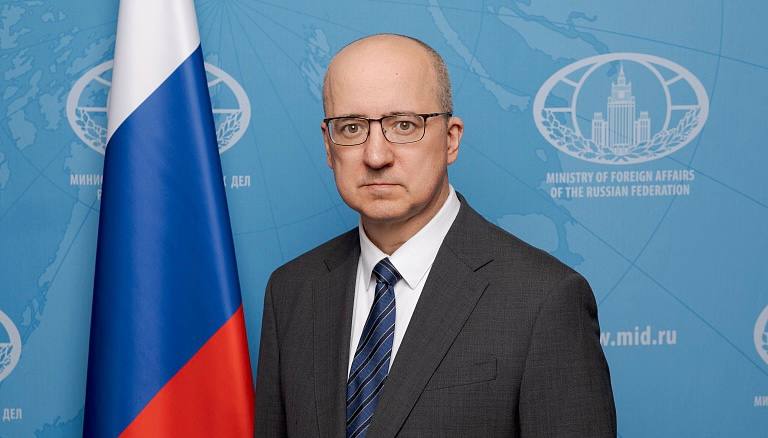
The Embassy of the Russian Federation in Ghana has asserted that Russia remains a consistent and predictable partner to Ghana, rejecting claims by the EU Ambassador to Ghana questioning the country’s credibility as a partner.
The statement released by the Russian Embassy addressed a number of issues raised by the EU Ambassador, including allegations of the illegal recruitment of Ghanaians by Russia to fight in the war against Ukraine and concerns over Russia-linked projects that are yet to be realised.
The Russian Embassy, in strongly worded remarks, rejected the claims, describing the EU Ambassador’s position as patronising and accusing the European Union of repeatedly taking swipes at Russia.
The Embassy responded to concerns raised by the EU Ambassador, Rune Skinnebach, over the yet-to-be-realised Rosatom nuclear project, the proposed Russia Export Centre facility and railway projects intended to connect Accra to Paga.
According to the Russian Embassy, the implementation of some of these projects has been affected by obstacles created by Western sanctions rather than Russia’s unwillingness to fulfil its commitments.
The Embassy stated that “unilateral” sanctions imposed by the United States, the EU and their allies, including secondary sanctions and threats against African banks, companies and individuals, had affected financial transactions, logistics and payments required to facilitate the projects highlighted by the EU Ambassador.
“Illegal unilateral restrictions imposed by the US, the EU and their allies – including secondary sanctions and threats against African banks, companies and individuals – are leading to the blocking of financing, logistics and payments.” the Embassy stated.
The Russian Embassy further claimed that Western banks were refusing to process transactions involving Russian entities, while Ghana and other African countries were allegedly being threatened with exclusion from dollar-denominated settlements.
It argued that such restrictions were contributing to delays in the implementation of some Russia-Ghana projects and disputed suggestions that the delays were the result of Russia’s failure to honour its commitments.
The Embassy also described Western sanctions as a form of neo-colonial pressure on Africa, alleging that they were intended to restrict the continent’s access to alternative development partnerships.
“The cause lies not with Russia, but in the stifling sanctions regime that the EU is imposing on legitimate cooperation between sovereign states. Sanctions are a tool of unfair competition and neo-colonial pressure, directed, among other things, against Africa. In effect, attempts are being made to deprive the continent of alternative paths to developmentt,” the Embassy stated.
The Embassy further stated that Russia’s trade volume with Ghana had recorded growth during the first half of 2026, although it did not disclose the current figure.
The EU Ambassador, speaking at Ukraine’s 35th Independence Day celebration organised by the Ukrainian Embassy in Accra, had called on Ghana to defend international law notwithstanding its longstanding non-alignment policy.
In response, the Russian Embassy raised allegations against some EU member states over their role in the Sahel, accusing them of contributing to instability in the region.
The Embassy also criticised what it described as the EU’s approach to Africa, alleging that the bloc viewed the continent as a sphere of geopolitical influence and sought to maintain its influence through economic dependence.
It contrasted this with Russia’s approach, saying Moscow had no colonial history in Africa and based its relations with African countries on what it described as equality and mutual benefit.
“The EU Ambassador called on Ghana to defend international law and the sovereignty of states. This sounds cynical coming from a representative of an organisation whose member states bear direct responsibility for the destabilisation of the Sahel” the statement read.
The Russian Embassy also rejected the concerns raised during Ukraine’s Independence Day celebration over the return of Ukrainian children allegedly taken to Russia during the war.
The Embassy described the calls for the return of the children as part of what it characterised as a broader anti-Russian campaign by Ukraine and Western countries, accusing them of seeking to promote what it considers a false narrative about Russia among Ghanaian and African audiences.
The Embassy claimed that despite Ukraine’s repeated references to thousands of children allegedly taken to Russia, Kyiv had provided Russia with the names of only 339 children. According to the Embassy half of the list was irrelevant while the remaining cases were being investigated by the relevant authorities.
The Embassy also rejected allegations that Russia had forcibly displaced or deported Ukrainian children, maintaining that children had been evacuated from areas affected by fighting to protect their lives and health and to reunite families separated by the conflict.
It stated that communication channels had been established with the Ukrainian side to facilitate the reunification of children with their relatives, with the involvement of the International Committee of the Red Cross and other intermediaries.
The Embassy further claimed that Russia was searching for children separated from their parents who were currently in Ukraine or elsewhere in Europe. It said Russia had handed Ukraine a list of 20 children but claimed that none had been returned.
On the alleged recruitment of Ghanaians and a number of Africans to participate in the war by Russia, the Embassy alleged that the West had turned Ukraine into what it described as “a magnet for mercenaries” from around the world, while also recruiting its own nationals.
“The EU Ambassador, whilst lamenting the alleged ‘illegal recruitment’ of Ghanaian citizens, ‘discreetly’ fails to mention that the West has long and openly turned Ukraine into a magnet for mercenaries from all over the world. Certain EU countries are, in fact, recruiting their own citizens to take part in hostilities against Russia.” the statement read.
The Embassy maintained that claims of Africans being illegally recruited through deceptive schemes were false, arguing that Russian law permits foreign nationals to serve in its military on a contractual basis.
“Russian legislation permits foreign nationals to undertake military service on a contractual basis. However, claims that Russia is allegedly deliberately engaged in any form of illegal recruitment of citizens from African states using ‘deceptive schemes’ are simply untrue,” the statement read.
The Embassy also criticised the EU over what it described as an education system influenced by LGBT-related and other “pseudo-liberal” ideas, which it claimed undermine traditional family values. It maintained that Russia’s approach to education and patriotic upbringing was morally sound and constructive.
The Embassy reiterated that Moscow considers itself a reliable and equal partner to Ghana, maintaining that it would not dictate terms but instead offers Ghana additional opportunities for cooperation.
“Russia has been, is, and will remain a reliable, predictable and equal partner to Ghana. We do not lecture or dictate terms. We offer Ghana, first and foremost, additional opportunities. And that is what really matters,” the statement read.
Related Posts