
Cheering children – check. Military honour guard – check. Cannon fire and marching band – check.
Vladimir Putin’s welcome outside the Great Hall of the People was a near mirror image of the reception for Donald Trump last week.
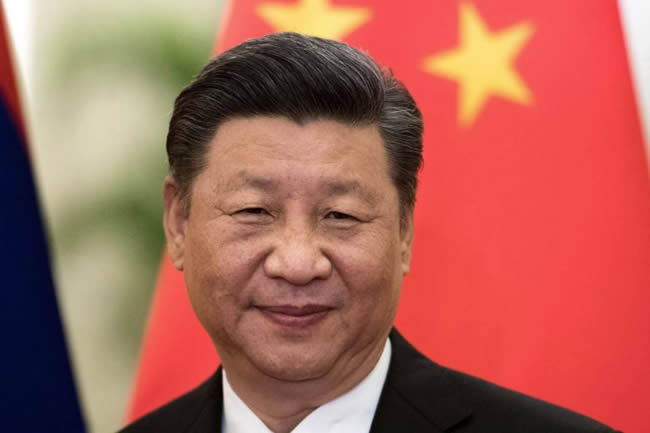
Two high-stakes presidential visits, just days apart, is exactly the image Xi Jinping wants to project to the world: talking to everyone, tied to no-one.
For China, these visits are proof that because of its massive economy and new-found diplomatic clout all roads now lead to Beijing.
“The new era of world affairs is less centered around the West,” says Samir Puri from Kings College London.
“There is a lot of latent power that China has on the world stage, it’s not necessarily using it in its most direct form to settle conflicts, instead China’s style is to try to utilise its stature in a more gradual sense.”
The optics were strikingly similar – Xi confident in the spotlight as he played host. But the politics driving the two visits were very different.
Putin, who has been to China more than 20 times, appears to have a close personal relationship with Xi. But the war in Ukraine and Western sanctions have left him leaning heavily on Beijing, which is now Russia’s top trading partner and its biggest customer for oil and gas.
It has been an unequal partnership for some time now, and that was reinforced today. Talks ended with 20-plus agreements on trade and tech, but no approval yet for the stalled Russian gas pipeline that Putin has been pushing for years. A lengthy joint statement also yielded no major breakthroughs.
“Both China and Russia need each other, but Russia clearly needs China more than before at the global stage,” says Dr Zheng Runyu, from the Centre for Russian Studies at the East China Normal University in Shanghai.
“Given today’s international environment, deep co-operation with China is extremely important for Russia in dealing with many of its current challenges.”
The Chinese leader seemed to have a strong hand as he negotiated with the US president too. Stronger trade relationships with the rest of the world and China’s dominance in rare earth minerals and advanced manufacturing have given him leverage. Beijing has found itself on an equal footing with Washington in the wake of Trump’s unpredictability.
And in talks with both Trump and Putin, Xi faced leaders mired in costly wars that have dragged on for longer than they anticipated. For Trump, the war in the Middle East has turned into a global crisis that has plunged his approval ratings back home. For Putin, the invasion of Ukraine, now into its fifth year, has isolated Russia and taken a brutal toll even on its own people.
In both cases, it also seemed apparent that now China has the power to set the tone and the terms of how it wants to engage on the global stage.
Xi’s Chinese dream
This is a remarkable turnaround for a country that, just five years ago, appeared to be on the verge of diplomatic isolation.
Its borders were closed due to a pandemic that then president Trump had labelled a “Chinese virus”. Relations with the West had deteriorated sharply amid the rise of so-called “wolf warrior” diplomacy, where Chinese diplomats and state media used aggressive rhetoric to quieten Western critics.
There was also growing international criticism over grave human rights abuses in Xinjiang, and Beijing’s increasing control over Hong Kong, and Western governments imposed sanctions and export controls on Chinese goods. China responded with counter measures.
And yet, five years on, China has repositioned itself as an indispensable centre of global diplomacy and trade.
Rather than being treated as a problem to contain, China has become a power to engage.
Beijing has moderated its diplomatic style as it likely recognised uncomfortable realities. Its economic slowdown means that it needs more foreign investment and trade, which require stable ties. Its excessive confrontation was also driving important trading partners in the region, such as South Korea, the Philippines and Vietnam, closer to Washington.
But the timing is also key. Ever since the US elected Donald Trump, China has repaired ties with Australia, Canada and the UK – all key US allies. World leaders, including those from Canada, the UK and Germany, have walked Beijing’s red carpet to do deals with the world’s second largest economy.
For the last decade Xi has promised his people he would work towards “the great rejuvenation of the Chinese nation” and this last week has been an incredible piece of domestic propaganda: the Chinese leader looked like the man everyone wants to meet.
But this visit also highlights the limits of China’s diplomatic power.
Source: BBC
Related Posts