
Germany has contributed ¢1million in operational resources to the Ghana Immigration Service to strengthen Ghana’s border security and prevent the spillover of insurgent activity from the Sahel into its territory.
The support comes at a critical moment. Ghana recently recorded the tragic loss of eight lives, with three others injured, following an attack on tomato traders who had travelled to Titao in Burkina Faso to purchase supplies. The incident heightened cross-border security concerns and prompted intensified diplomatic engagements focused on protecting Ghanaian nationals operating within volatile areas of the Sahel.
As insecurity persists across parts of Mali, Niger and Burkina Faso, several international partners have pledged support to Ghana’s efforts to reinforce its northern frontier, while the country continues to balance regional camaraderie with its conflict-affected neighbours.
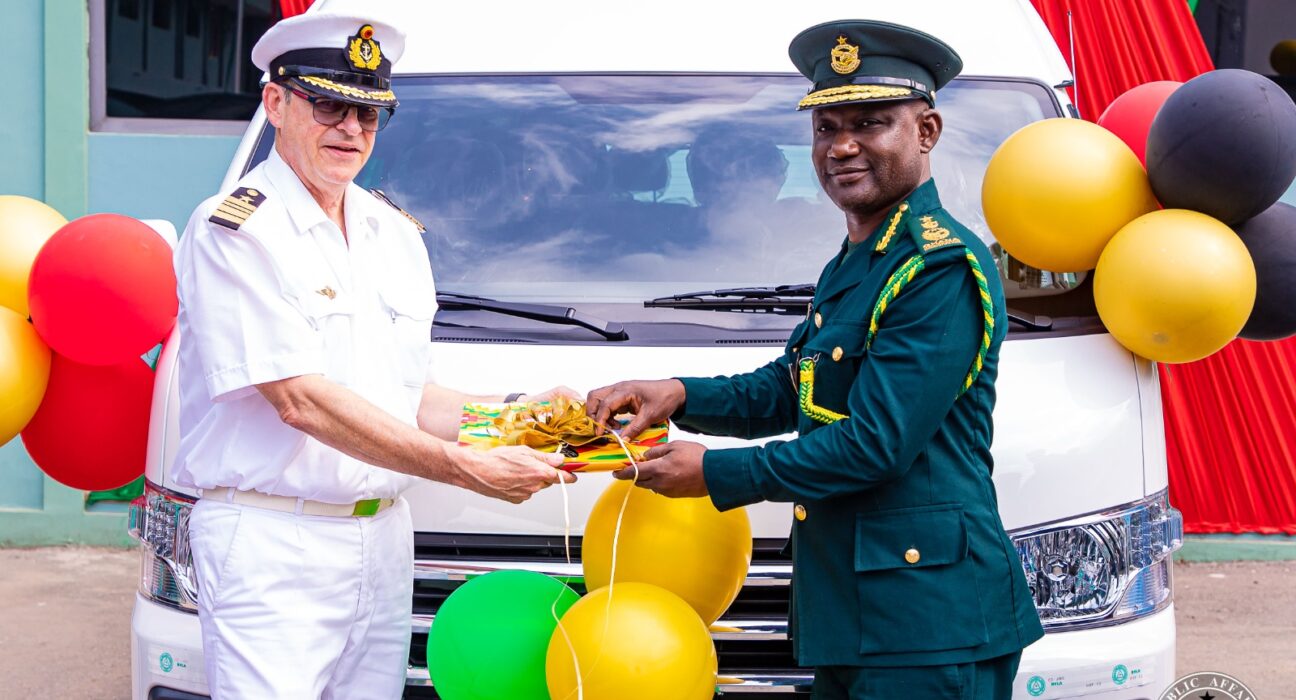
The German Defence Attaché, Holger Grossmann, presented the operational assets, including a 16-seater Foton View CS2 bus, laptops, tablets, printers, protective helmets and bulletproof vests, to the Comptroller-General of Immigration, Samuel Basintale Amadu. The equipment is expected to enhance mobility, improve operational coordination and strengthen officer safety along Ghana’s northern borders.
The resources are designed to improve rapid deployment capacity, field communication and frontline protection for immigration officers who serve as the first layer of defence in border management. With increased patrol mobility and upgraded equipment, the Ghana Immigration Service is better positioned to detect irregular movements, prevent arms trafficking and manage migration flows more effectively.
Germany has remained a strong defence partner to Ghana, operating within the broader framework of the European Union security cooperation architecture in Africa. Through technical exchange, shared doctrine development and joint training standards, Berlin has supported enhanced interoperability between European and African security institutions, strengthening multinational coordination in response to emerging threats.
This latest intervention complements earlier commitments by the United States to deepen security cooperation with Ghana. During a recent visit by the Air Force Commander of United States Africa Command to President John Mahama at the Jubilee House, discussions focused on bolstering security collaboration as a foundation for economic stability, trade growth and regional peace.
Ghana has, in parallel, outlined comprehensive domestic security measures. These include operationalising two forward operating bases in Jirapa and Hamile, intensifying surveillance along high-risk corridors and deploying Defence Attachés to Mali, Niger and Burkina Faso to strengthen intelligence coordination and diplomatic-security engagement.
Another notable German contribution falls under the auspices of the European Union Strategic Defence Initiative Gulf of Guinea (EU SDI GoG). Through the German detachment of the initiative, Ghana’s Army Combat Training School has launched a two-week Training-of-Trainers programme focused on assault river crossing operations. The exercise, which commenced on 16 February 2026, brings together 30 selected personnel from across the Ghana Armed Forces to build instructor-level capacity in complex mobility and tactical operations.
The growing defence collaboration reflects a shared commitment between Germany and Ghana to secure borders and promote safe, well-managed migration. By investing in institutional capacity, operational readiness and strategic cooperation, both countries are working to enhance stability in the sub-region — recognising that effective border governance is essential not only for national security, but also for sustained economic opportunity and regional integration.
Related Posts