
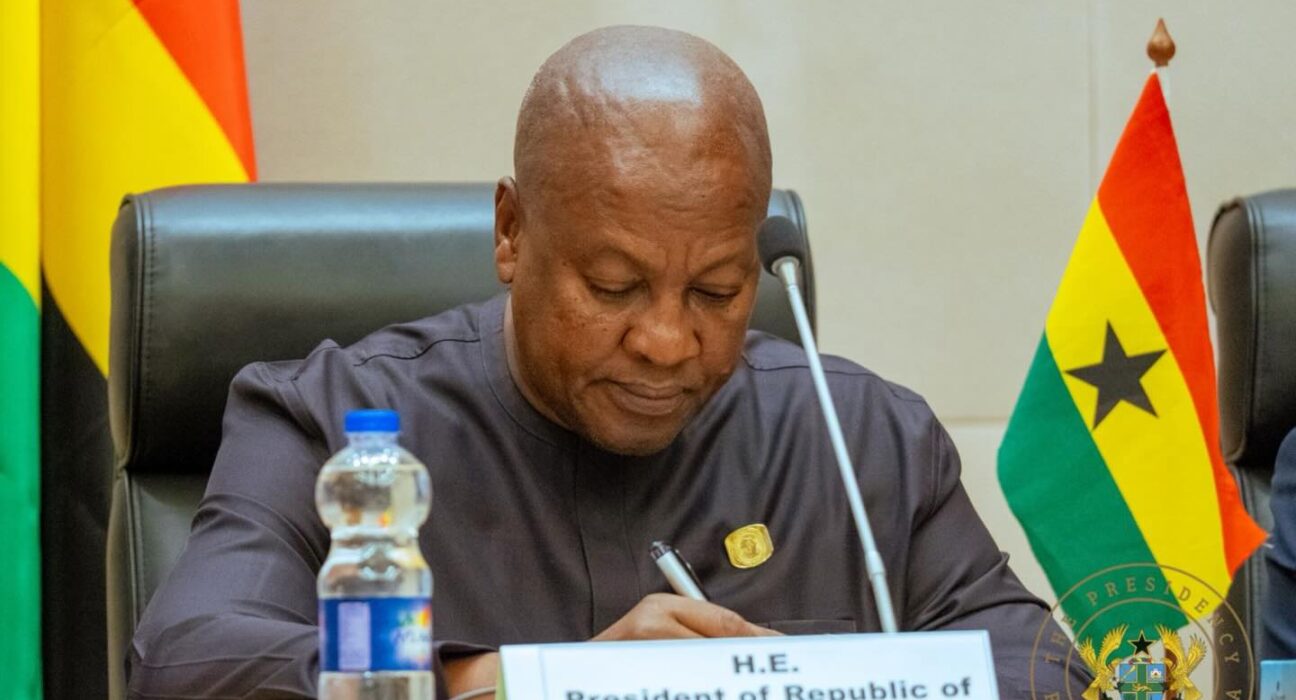
President John Dramani Mahama has been named First Vice Chair of the African Union (AU) for 2026 at the 39th Ordinary Session of the Assembly of Heads of State and Government in Addis Ababa.
His election places Ghana at the heart of the Union’s leadership structure, reinforcing the country’s role in shaping continental policy and high-level decision-making. The Bureau for 2026 will be chaired by Évariste Ndayishimiye of Burundi, with Tanzania serving as Second Vice Chair, a North African representative yet to be confirmed as Third Vice Chair, and Angola as Rapporteur.
Mahama’s elevation comes amid renewed continental conversations on African sovereignty, institutional reform and financial independence. As a leading voice on governance and economic transformation, he has consistently advocated stronger regional integration and collective African positions on global platforms, arguing that the continent must assert its strategic interests within multilateral systems.
Notably, President Mahama has played an active role in championing reparatory justice for Africa and the diaspora, aligning with ongoing African Union efforts to advance discussions on reparations for historical injustices, including slavery and colonial exploitation. His stance reflects a broader push for recognition, restitution and structural redress within international frameworks.
In addition, Mahama has been vocal on the need for financial sovereignty, calling for reforms to global financial architecture, fairer access to development financing and reduced dependency on external funding. As First Vice Chair of the AU, he is expected to leverage this platform to strengthen Africa’s collective bargaining power, promote sustainable economic policies and support the implementation of Agenda 2063 priorities.
The leadership transition took place against the backdrop of a summit anchored on the theme, “Assuring Sustainable Water Availability and Safe Sanitation Systems to Achieve the Goals of Agenda 2063.” As such, water security dominated deliberations, with leaders describing access to water as a political, moral and strategic imperative tied directly to development, food security, public health and long-term stability.
Beyond the thematic focus on water and sanitation, discussions quickly broadened to the wider continental agenda.
Chairperson of the AU Commission, Mahmoud Ali Youssouf, said the summit comes at a time of mounting geopolitical turbulence, marked by persistent conflicts, institutional fragility and a resurgence of unconstitutional changes of government in parts of the continent. Against this backdrop, he urged member states to accelerate political and economic integration under the vision of Agenda 2063.
Building on that concern, Youssouf stressed that institutional reform and financial self-reliance have become imperative as external funding declines. He called for stronger domestic resource mobilization and faster implementation of flagship continental programmes, including industrialization, agricultural transformation, energy development and infrastructure expansion. He further emphasized that this decisive decade of Agenda 2063 must produce measurable results for Africa’s youth, women and civil society.
In his opening address, outgoing AU Chair President João Lourenço described access to water as a political, moral and strategic priority essential for development, public health, food security and stability. Reflecting on Angola’s tenure, he pointed to progress in advancing Agenda 2063, mobilizing infrastructure investment, strengthening continental integration through the African Continental Free Trade Area (AfCFTA), and promoting reforms aimed at improving AU efficiency.
Turning to peace and security, Lourenço maintained that Africa’s development depends on sustained efforts to “silence the guns.” He highlighted ongoing conflicts in Sudan and the Democratic Republic of the Congo, as well as terrorism in the Sahel and the Horn of Africa, reaffirming the AU’s rejection of unconstitutional changes of government and cautioning against legitimizing coups through subsequent elections.
Meanwhile, Ethiopian Prime Minister Abiy Ahmed urged African countries to move beyond reacting to global developments and instead actively shape the international agenda. He called for unity and stronger continental influence, pointing to Ethiopia’s investment in technology, including the establishment of an Artificial Intelligence institute and plans for an AI university, as part of efforts aligned with Agenda 2063.
Complementing these remarks, United Nations Secretary-General António Guterres underscored the importance of deepening the strategic partnership between the UN and the AU. He emphasized multilateral cooperation as vital for peace, security and sustainable development, while reiterating support for Africa’s industrialization, equitable access to financing and reform of the UN Security Council to strengthen African representation.
Related Posts