
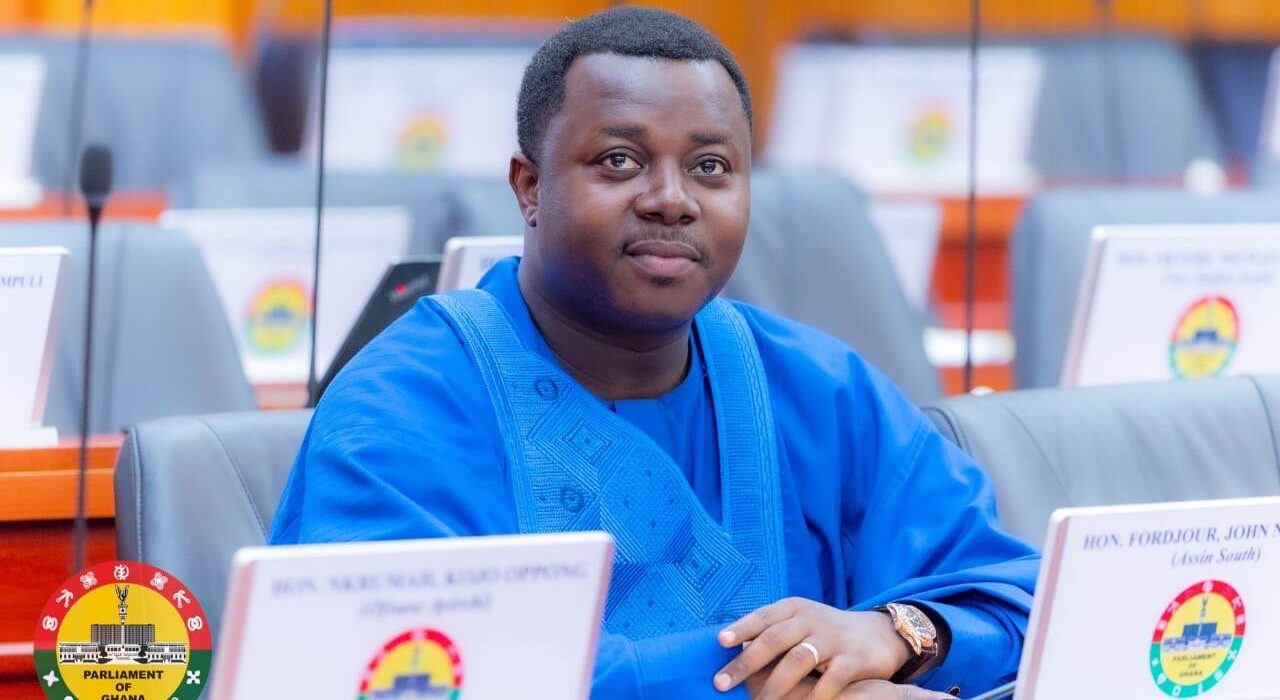
The Ranking Member of Parliament’s Defence and Interior Committee, Rev. John Ntim Fordjour, has defended Ghana’s position on the Israeli-Palestinian conflict, insisting that the country has remained consistent in its support for a two-state solution despite concerns about its seeming alignment in the conflict.
Speaking during a panel session at a symposium on Terrorism in the Middle East and Africa, the Assin South MP maintained that Ghana’s position supports the establishment of an independent Palestinian state alongside Israel, with both countries living in peace and security.
The Symposium was organized by the Embassy of Israel as it commemorated three years after the October 7 massacre by Hamas.
Rev. Fordjour’s response followed a question from Israel’s Ambassador to Ghana, Roey Gilad, who questioned why Ghana appeared less vocal in its response to Russia’s invasion of Ukraine but had taken a more pronounced position on the Israeli-Palestinian conflict.
Ambassador Gilad’s question centred on what he perceived as a difference in Ghana’s approach to the two conflicts, particularly its criticism of Israel’s actions in the Middle East compared with its response to Russia’s military aggression against Ukraine.
In response, Rev. Ntim Fordjour noted that even Ghana’s former Film Ambassador to Israel could attest to the state position on a two-state solution.
However he argued that Israel had faced persistent threats from both state and non-state actors, adding that every country had a responsibility to take necessary measures to protect its population and national security interests.
Drawing on Ghana’s National Security Strategy, Rev. Ntim Fordjour noted that terrorism was recognised as a serious threat to countries’ domestic security and resilience, requiring governments to take appropriate steps to protect their citizens.
He said Israel’s security concerns could not be ignored, particularly in view of threats by non-state actors who had repeatedly expressed intentions to destroy the country.
“If you have a situation where a country is faced by public pronouncements by non-state actors, continuously and consistently, to the effect that they will not rest until that country is wiped out, and if I were a member of that country, definitely, I would also be minded: what do I do to protect my people, to protect my national security interests?” he asked.
Rev. Ntim Fordjour also cited the October 7, 2023, Hamas-led attacks on Israel, questioning whether the attacks could be classified as anything other than terrorism.
“If October 7 was not terrorism, then what is terrorism?” he asked, adding that he had observed that 44 countries had recognised the attacks as terrorism.
He maintained that countries facing threats from state and non-state actors were entitled to consider measures necessary for their survival and security, while emphasising the need to understand the broader geopolitical circumstances surrounding the conflict.
However, Ghana’s official position, as reiterated by President John Dramani Mahama at the 81st session of the United Nations General Assembly in September 2026, is support for a viable two-state solution that allows Israel and Palestine to coexist peacefully within secure and guaranteed borders.
President Mahama also condemned acts of terrorism by Hamas and called on all parties to respect international humanitarian law, stressing that the same standards must apply across conflicts.
Rev. Ntim Fordjour’s remarks therefore placed the debate on Ghana’s approach to the Middle East conflict within the broader discussion of national security, terrorism and the country’s longstanding support for a negotiated political settlement
Related Posts