
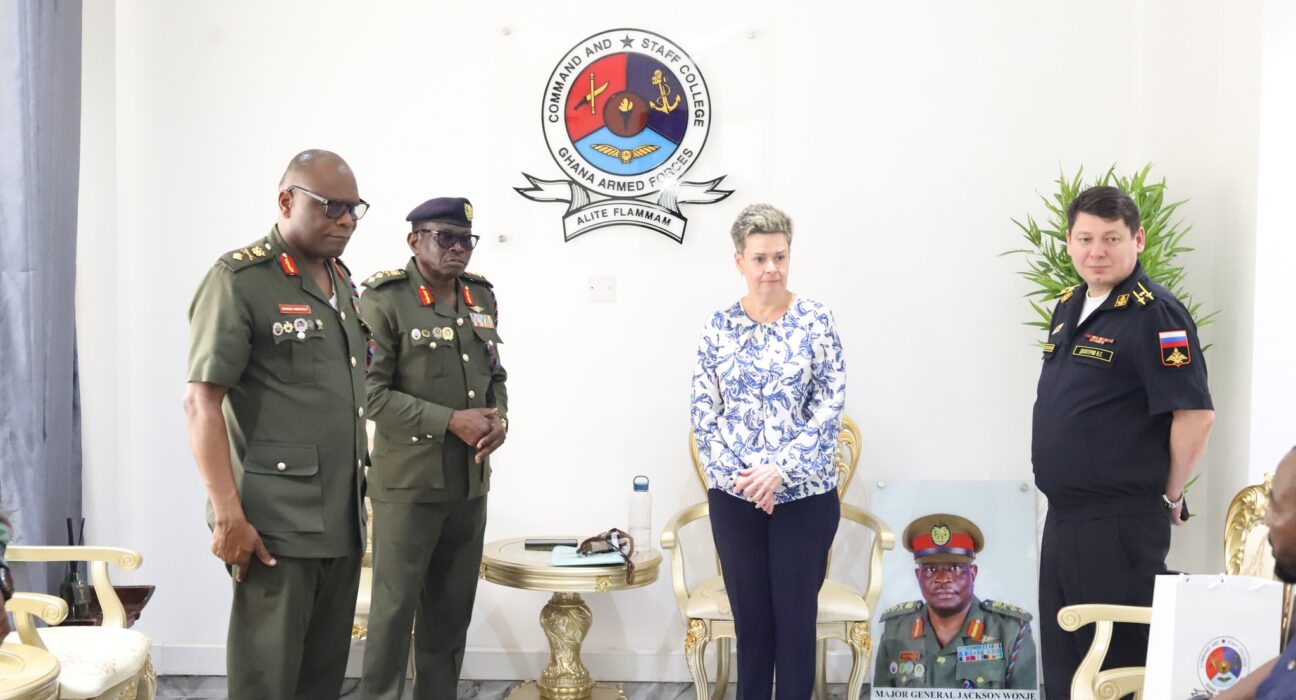
The Embassy of the Russian Federation in Ghana has outlined Moscow’s foreign policy priorities in Africa during a guest lecture delivered to students at the Ghana Armed Forces Command and Staff College as part of a Foreign Policy and Diplomacy course.
Counsellor at the Russian Embassy, Natalia Muzhennikova, led the lecture on behalf of the Embassy, highlighting key pillars of Russia’s engagement with Africa. These included Russia’s political support for African countries, expanding Russia–Africa trade relations, military-technical cooperation with African states, and the activities of the African Corps of the Russian Armed Forces, which has increasingly featured in Moscow’s security partnerships across the continent.
The session also examined broader geopolitical developments shaping Russia’s foreign policy, including global security tensions and Moscow’s support for the expansion of BRICS. Russia’s position emphasises BRICS as a growing economic and financial alternative aimed at reducing reliance on the dominance of the United States Dollar and promoting multipolar global trade arrangements.
The interactive question-and-answer session further explored Russia’s engagement in Africa’s evolving security landscape, particularly in regions facing instability and terrorism, as well as the implications of Russia’s strategic partnerships with African states.
She was accompanied by Captain First Rank Viktor Dolgerov, Russia’s Military Attaché in Ghana, and Major Yevgeny Boyarkin, Deputy Military Attaché, who also participated in the engagement.
Russia’s growing presence in Africa, however, has attracted increasing scrutiny from Western governments, policy analysts, and international observers. Analysts note that Moscow has expanded its influence through a combination of military cooperation, arms sales, and security partnerships, particularly in the Sahel and Central Africa.
In countries such as Mali, Burkina Faso and the Central African Republic, Russia has stepped into security gaps left by Western partners, offering military training, weapons, and security assistance, often alongside economic agreements in mining and energy sectors.
However, critics argue that Russia’s security model, previously linked to the Wagner Group and now replaced by the Africa Corps under direct Russian Defence Ministry control, has raised concerns about transparency, governance, and human rights.
Reports indicate that Russia’s Africa Corps, which took over Wagner’s footprint after 2023, is now active in several African countries, with its operations drawing both support from governments seeking security assistance and concern from international observers over accountability and long-term strategic influence.
Russia’s engagement with Africa also intersects with its broader push to strengthen BRICS cooperation. Moscow views BRICS expansion , particularly the inclusion of more Global South countries ,as a strategic effort to promote alternative trade systems, local currency transactions, and reduced dependence on Western-dominated financial institutions.
The lecture formed part of ongoing diplomatic engagements between Russia and Ghana, aimed at deepening understanding of global geopolitics, emerging alliances, and the evolving multipolar international order.
Related Posts