
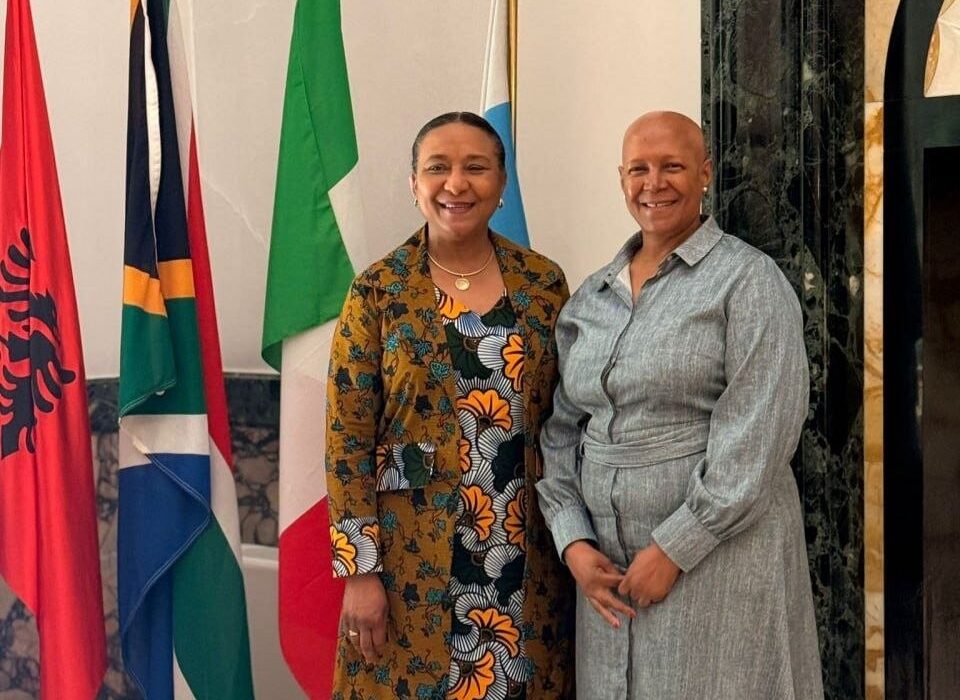
Ghana’s Ambassador to Italy, Mona Quartey, and the Head of the South Africa Mission to Italy, Nosipho Nausca‑Jean Jezile, have renewed their commitment to aligning their diplomatic objectives in the broader interest of advancing Africa’s food security agenda.
The two diplomats emphasized the need to strategically steer engagement with Italy and the UN Rome-based food agencies toward sectoral priorities critical to Africa’s development. These include agriculture and agribusiness, food security, trade, climate-resilient farming, and sustainable development.
Their engagement also signals a renewed commitment by African Heads of Mission in Rome to foster unity within the African diplomatic corps and strengthen coordinated advocacy to ensure Africa’s priorities remain central within global food security frameworks.
The UN Rome-based agencies, Food and Agriculture Organization (FAO), International Fund for Agricultural Development (IFAD), and World Food Programme (WFP) , have had a substantial impact on the African continent over the years.
Their interventions have focused heavily on tackling rising hunger, malnutrition, and food system vulnerabilities, while promoting climate-resilient agriculture, strengthening local food supply chains, and expanding Home-Grown School Feeding programmes.
Despite these interventions, Africa continues to grapple with significant food security challenges. Nearly 95% of food production in Sub-Saharan Africa is rain-fed, making agricultural output highly vulnerable to climate variability and extreme weather events.
Declining investment in farm inputs such as improved seeds, fertilizers, irrigation infrastructure, and mechanization further constrains productivity. Additionally, insecurity and conflict across the Sahel and Horn of Africa continue to disrupt farming activities and food supply chains.
In the case of Ghana, it continues to face growing food security concerns driven by climate variability, rising food prices, and post-harvest losses. According to the World Food Programme, northern Ghana remains particularly vulnerable, with erratic rainfall, prolonged dry seasons, and flooding affecting crop yields and household food availability.
Additionally, inflationary pressures and high fertilizer costs have impacted smallholder farmers, who produce over 70% of Ghana’s food supply.
The Food and Agriculture Organization has also highlighted that Ghana loses between 20 and 30% of agricultural produce annually due to inadequate storage, transportation, and processing infrastructure. These losses significantly undermine food availability and farmer incomes.
UN Rome-based agencies can support Ghana through improved storage technologies, irrigation expansion, climate-smart agriculture, and strengthening the country’s Home-Grown School Feeding Programme to create stable markets for farmers.
While South Africa is one of Africa’s largest agricultural producers, it continues to face food insecurity driven by inequality, climate shocks, and rising food costs. According to the World Bank and World Food Programme, millions of South Africans experience moderate to severe food insecurity despite national food availability, largely due to unemployment and income disparities.
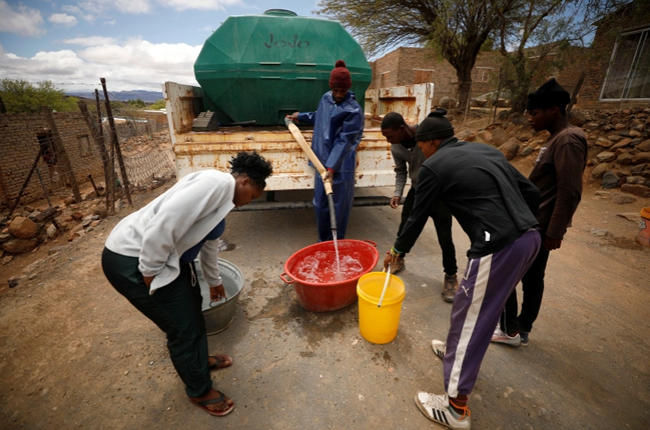
Recurring droughts, particularly in provinces such as the Eastern Cape and Limpopo, have also affected crop production and livestock farming. The UN Rome-based agencies can support South Africa through climate-resilient agriculture, improved water management systems, rural livelihood development, and strengthening food supply chains to enhance affordability and accessibility.
The renewed Ghana-South Africa diplomatic collaboration in Rome therefore positions both countries to leverage partnerships with the UN Rome-based agencies to strengthen food systems, enhance agricultural productivity, and accelerate progress toward achieving United Nations Sustainable Development Goals, particularly Goal 2, Zero Hunger.
The move underscores a broader African diplomatic push to ensure that global food security policies reflect the continent’s priorities while unlocking sustainable solutions to hunger, climate vulnerability, and agricultural transformation across Africa.
Related Posts